

WSU Athletic Hall of Fame Members
(By Last Name)
A | B | C | D | E | F | G | H | I | J | K | L | M | N | O | P | Q | R | S | T | U | V | W | X | Y | Z | Teams
 HAROLD AHLSKOG (2012)
A three-year letterwinner for the Cougar football team (1928-30), Harold Ahlskog arrived on campus from Spokane, Wash., helping WSC to a 26-6 record in his three seasons. After winning 10 games in 1929, a year in which he garnered all-state honors, Ahlskog and his teammates won their first nine games of 1930, earning a trip to the 1931 Rose Bowl where WSC fell to Alabama. The 1930 Washington State College football team featured three All-Americans on the offensive line and while Mel Hein and Glenn "Turk" Edwards captured many of the headlines, Ahlskog matched them for his work in the
trenches that season. Ahlskog was a New York Post First Team All-America selection and received the 1930 J. Fred Bohler Award. Ahlskog earned a degree in science in mining in 1932.
 HARRY "HACK" APPLEQUIST (1989)
Harry A. Applequist holds a special place in Cougar football history, having played and starred in the first of the official Rose Bowl Games when WSU beat Brown 14-0 Jan. 1, 1916. Applequist received All-America honors that year and later was named to the all-time Rose Bowl team at guard by Los Angeles columnist Bill Henry. After WWI, Applequist returned to WSU as an assistant football coach, serving from 1920 through 1925. For four years, 1923-26, he directed WSU's baseball program, compiling a 66-29-1 record. His successor was "Buck" Bailey. Applequist then headed for Sacramento and until his death in 1976 he was one of the most respected educators to ever serve the Sacramento educational system. He rebuilt a floundering Sacramento High football program and then took on the challenges of a struggling Sacramento City College, serving as head football and baseball coach during his 1929-41 career. In 1940 he joined the Sacramento School District, remaining until his retirement in 1956. After his retirement he served in a variety of positions with the National Education Association and Department of Health, Physical Education and Recreation. He was the author of three books, was elected to the Sacramento Hall of Fame and received the "Emeritus Award" from the NHPEA.
 DOMINIQUE ARNOLD (2017)
Dominique Arnold arrived at WSU as a junior with a sketch pad and a No. 4 national junior college ranking in the high hurdles. Arnold, an accomplished artist known to draw on every plane trip, embraced the Cougars weight training program which translated into faster times on the track. He won the 1996 MPSF Indoor 55m hurdles title and ran a 7.27 seconds PR in the NCAA Indoor prelims. That spring, after a runner-up finish at the Pac-10 Championships, Arnold won the NCAA outdoor title, but not without drama. After clocking in a 13.32w in the prelims and 13.39 in the semifinals, Arnold was dead last over the first hurdle in the final. He passed a competitor with each hurdle and into the 10th hurdle was third but stayed patient. He cleared the final hurdle cleanly while both leaders hit the last hurdles. Arnold won the 110m high hurdles title with a time of 13.46, becoming WSU's 34th NCAA individual champion. As a professional, Arnold was the runner-up at the 2005 and 2007 USA Outdoor Championships, won bronze at the 2006 World Indoor Championships and gold at the 2006 USA Outdoor Championships. He holds the equal sixth-fastest all-time performance in the 110m hurdles with a time of 12.90 seconds which was the American record from 2010 till 2012. He was ranked from third to 10th-best in the World and from second to eighth-best in the U.S.
 RICK AUSTIN (2012)
Rick Gerald Austin was born Oct. 27, 1946 in Seattle. He attended Lakes High School in Tacoma, Wash., where he competed in football, basketball and baseball. In 1968, he led the nation with 12 wins and tied a then-Washington State single-season record. His 1.10 ERA in 1968 is third all-time at WSU and his 1.33 mark in 1967 ranks fifth. He was a Pac-8 All-Star, a NCAA District First Team selection and a Second Team All-American in 1968. He was a first round pick of the Cleveland Indians in the June Secondary Phase of the MLB Draft in 1968. Austin spent part of four seasons in MLB, two with the Indians and two with the Milwaukee Brewers. He appeared in 89 games, including eight starts, winning four and saving six.
 BUCK BAILEY (1978)
Arthur “Buck” Bailey came to Washington State as an assistant football coach and became a legend as its colorful and winning head baseball coach (1927-42, 1946-61). At WSC, Bailey’s teams won 11 Northern Division titles, including 10 outright. The Cougars made two trips to the College World Series under Bailey and his 1950 squad finished national runner-up to Texas. In his 32 seasons, Washington State won 603 games and the current baseball home for the Cougars is named in his honor. He played football and baseball at Texas A&M and Bethany (W.Va.) and was captain of the 1925 West team in the first East-West Shrine Game. Bailey is a member of the State of Washington Sports Hall of Fame and the Inland Northwest Sports Hall of Fame.
 BY BAILEY (1985)
Byron Bailey was a star at Washington State from 1949-51. Bailey rushed for a then-school record 695 yards in 1951 and finished his career with 1,251 yards, a Cougar record at the time. He was an All-West Coast second teamer by AP as a senior and won the J. Fred Bohler Award for inspiration. In 1952 he was drafted by Detroit and a member of the Lions’ NFL championship team that year. After playing the 1953 season with the Green Bay Packers, Bailey moved north of the border and spent 11 seasons (1954-64) with the British Columbia Lions of the Canadian Football League. He rushed for 3,643 yards in eight seasons before converting to defensive back for the final-three years of his career. He was a member of the 1964 Grey Cup champion. In 1975, Bailey was inducted to the Canadian Football Hall of Fame and the BC Sports Hall of Fame.
 ED BARKER (2012)
Ed Barker set the standard for those that followed. A three-year letterwinner at Washington State (1950-52), Barker was a First Team All-Pacific Coast Conference and Associated Press All-West Coast selection in 1951 after setting WSC, PCC and NCAA records with 864 receiving yards. Despite playing in a run-oriented offense that year, Barker also set WSC records with 47 receptions and nine touchdowns. He concluded his Cougar career by breaking the NCAA’s three-year yardage record with 1,699 yards. In addition to his football achievements, Barker was an outstanding track man for WSC, excelling in the high jump and hurdles while earning three letters. He finished seventh in the decathlon at the 1952 United States Olympic Trials. The 12th overall pick in the 1953 NFL Draft by the Los Angeles Rams, Barker played professionally in 1953 (Pittsburgh Steelers) and 1954 (Washington Redskins). Following his football career, he became an officer in the United States Air Force retiring as a Lt. Colonel.
 STAN BATES (1980)
Stan Bates is remembered by thousands of people in the West for his outstanding service to education and athletics as a coach, high school principal, college admission officer, director of athletics and conference commissioner. He earned 10 varsity letters in three sports at the University of Puget Sound and later coached at Monroe High School and was a coach and principal at Snohomish High School. Bates joined the Washington State faculty in 1953 as associate director of admissions and a year later was named athletic director, a post he held for the next 17 years. He served on numerous NCAA committees. From 1971-80, he was the commissioner of the Western Athletic Conference and the scholar-athlete award for the conference is named in his honor. Bates is a member of the Inland Northwest Sports Hall of Fame.
 PAT BEACH (2015)
When Pat Beach decided on a college, he didn’t have far to go. Beach arrived at Washington State following a stellar prep career at Pullman High School, where he was a two-time all-league tight end and middle linebacker, as well as being a prep All-American. The transition to WSU was minimal, as he started at tight end as a sophomore, where he would stay for the next three seasons. Over that span he caught 63 passes, a record for tight ends, for 936 yards and five touchdowns. He was a two-time All-Pacific-10 Conference performer and as a senior was named a first-team All-American by The Sporting News and second team by the Newspaper Enterprise Association. As co-captain during the 1981 season, he helped the Cougars to their first bowl appearance in 50 years as WSU faced BYU in the Holiday Bowl. Beach capped his collegiate career by playing in the East-West Shrine Game and the Olympia Gold Bowl. Beach was selected with the first pick in the sixth round by the Baltimore Colts in the 1983 NFL Draft. He spent 12 years in the NFL, 10 with the Colts, one with the Philadelphia Eagles and one with the Phoenix Cardinals. He totaled 160 games, 163 receptions, 1,558 yards and 14 touchdowns in his NFL career.
 LARRY BECK (2015)
A native of South Bend, Wash., Larry Beck, known as the ‘Blonde Bomber from South Bend’, joined the Washington State men’s basketball team in the fall of 1954. At 6-foot-3, Beck was a forward for the Cougars, but was known more as a football player having been recruited by both Washington and Oregon State. But Beck chose basketball and he had an immediate impact on his WSC team his first season, averaging 10.0 points and 4.6 rebounds for head coach Jack Friel. As a junior he averaged 19.5 points per game along with 8.2 rebounds an outing, on his way to Pacific Coast Conference First Team honors in 1955-56. In his senior year, Beck averaged 19.1 points and 7.5 rebounds, leading the team in scoring for the third-straight year, while picking up his second-consecutive PCC First Team honor. Beck earned All-America accolades in 1957 and ended his career holding 19 individual records, including scoring with 1,263 career points, becoming just the third Cougar to reach the 1,000-point plateau. Following his collegiate career, Beck played with the Seattle Bakers and Los Angeles Jets, both members of the National Alliance of Basketball Leagues, and was inducted into the NABL’s Hall of Fame in 2004.
 LORIN "BILL" BENKE (1984)
Loren “Bill” Benke won the 1937 NCAA championship in the 440-yard dash, one of two All-American certificates he earned. That year he was a member of the mile relay team that set the Washington State, Pacific Coast Conference, NCAA, American and World Records. In 1935, Benke was the PCC champion in the 220-yard low hurdles and the long jump and was a member of the mile relay team that captured the conference title. In 1936, he was an All-American in the 440-yard hurdles and completed at the United States Olympic Trials in the event.
RON BENNINK (2012)
Ron Bennink was a three-year letterwinner (1953-55) on the hardwood for the Cougars. He scored 1,222 points in his career, and left Washington State with more than a dozen school and Pacific Coast Conference Northern Division records combined. As a junior, Bennink averaged 17.9 points per game and was named All-PCC First Team. A 6-foot-1 guard, he scored 288 of his 423 points as a senior in conference play to break the Northern Division record the South Dakota native set the year before. Bennink was a unanimous All-Northern Division selection and was named to the All-PCC First Team for the second-straight season.
 BILL BERRY (1989)
When William E. "Bill" Berry made the trip from Pullman High to WSU in 1957, he was considered too small at 5-6 to play football. Only Cougar wrestling coach Bill Tomaras had an interest in Berry, despite his previous success in football. Berry had won numerous prep football awards and was the outstanding grappler in the state for two years. At WSU he turned out for freshman football and won a starting spot at guard. When his sophomore season rolled around there was Berry, again a starting guard. He returned to the mat following each football season and for two years ruled the Pacific Coast Conference at the 147-pound division. Three times he earned trips to the NCAA Championships and twice in later years, 1964 and 1968, he just missed making the U.S. Olympic team, finishing second both times. Berry also spent over eight years in the U.S. Air Force. He made his home in Sacramento in 1970, became a CPA and entered the accounting and real estate business. Earlier, in 1967, he had earned an MBA from Michigan State. In 1982 Berry suffered extensive paralysis in a diving accident and is now restricted to a wheel chair. Having proved there was no quit in him as a 160-pound Cougar football Athlete, he is once again proving physical limitations will not get the best of Bill Berry.
 DON BERTOIA (2013)
Don Bertoia found success at Washington State and internationally as a middle distance runner after early success as a cross country skier. He won the bronze medal at the 1957 Canadian Junior Skiing Championships but an injury in 1958, and wanting to please coach Jack Mooberry, he abandoned the snow skis for track spikes. The British Columbia native won the 800 meters at the 1960 Canadian Indoor Championships and represented Canada on the 1961 European Track & Field Tour. Bertoia set the Canadian Indoor 880-yards record with a time of 1 minute, 50.3 seconds. In 1962 he ran a Rogers Field record time of 1:51.3 which was the 10th-fastest time in the nation. At the 1963 NCAA Outdoor Championships Bertoia finished third in the 880y with a school record time of 1:49.1 and earned All-America status. That same year he won a gold medal for Team Canada in the 800m and a bronze medal in the 1500m at the Pan American Games. His 800m time of 1:48.3 was a Pan Am Games and school record. At the 1964 Tokyo Olympics, Bertoia finished 24th in the 800 meters.
 GALE BISHOP (1978)
Gale Bishop was a scoring machine on the basketball floor. He set a Pacific Coast Conference Northern Division scoring record with 224 points in his sophomore season (1943), although he missed two games because of call-up to military duty. He was named All-PCC and Helms Foundation All-America, the same year he set an AAU single-game scoring mark with 50 points. He was an All-Northern Division choice in 1942, 1943 and 1946. Bishop is a member of the State of Washington Sports Hall of Fame and the Inland Northwest Sports Hall of Fame.
 DREW BLEDSOE (2001)
Drew Bledsoe was a record-setting quarterback at Washington State, 1990-92. He left school as the Cougars’ single-game and single-season record holder in pass attempts, pass completions, passing yards and total offense. He also tied the single-game mark for touchdown passes with five against Oregon State as a sophomore in 1991. Bledsoe’s career numbers of 7,373 passing yards and 46 touchdown tosses ranked him second in WSU history behind Jack Thompson when his career concluded. As a junior, he was named the Pacific-10 Conference’s MVP on offense, earned All-America honors, was a semifinalist for the Davey O’Brien Award, and finished eighth in the Heisman Trophy voting. Bledsoe capped his Cougar career leading WSU to a Copper Bowl win over Utah in 1992 and being named MVP in the game. He passed on his senior year in Pullman to enter the NFL Draft where he was selected No. 1 overall by the New England Patriots. He played 14 seasons in the NFL, was named All-Pro twice and selected to the Pro Bowl four times. He threw for over 44,000 yards in the NFL. Bledsoe was on two Super Bowl teams, including the Patriots when they won Super Bowl XXXVI. Bledsoe became a member of the New England Patriots Hall of Fame in 2011 and the State of Washington Sports Hall of Fame in 2012.
 J. FRED BOHLER (1978)
J. Fred “Doc” Bohler was a coach, teacher and athletic administrator at Washington State for almost half the 20th century. A member of the world champion Reading, Pa., basketball team in 1906, Bohler came to WSC in 1908 as physical director and coach of the school’s basketball and track teams. He is credited with introducing the one-hand push shot. Bohler Coached the Cougars to a championship their first year in the Pacific Coast Conference (1915). The Helms Foundation inducted him to its football hall of fame and its basketball hall of fame. He directed the physical education and athletic departments at WSU until 1950. Bohler is a member of the State of Washington Sports Hall of Fame and the Inland Northwest Sports Hall of Fame.
 WILBUR BOHM (1978)
Dr. Wilbur “Doc” Bohm was a pioneer in sports medicine and one of the world’s leading athletic trainers for nearly half a century. He wrote books on the subject and filmed a 1941 documentary about charley horses and sprained ankles. He was a founding member of the National Athletic Trainers’ Association and was inducted to the organization’s hall of fame in 1962. In 1926, Bohm came to WSC as an athletic trainers and the coach of the weights events for the track team. In 1932, he was one part of the first athletic training squad to serve a U.S. Olympic team, one of five Olympics he worked. Bohm also worked with MLB and NFL teams.
 CHUCK "BOBO" BRAYTON (1982)
It is nearly impossible to talk about Washington State baseball without Chuck “Bobo” Brayton being a part of the conversation. After becoming the school’s first baseball All-American in 1947, he turned to coaching. During his 33 seasons (1962-94) in the Cougar dugout, Washington State won 1,162 games and Brayton ended his career ranked fourth on the NCAA all-time victories list. He led the Cougars to 11-straight conference division titles (1970-80), including nine outright. Washington State made 10 appearances in the NCAA postseason under Brayton, including a trip to the College World Series in 1965 and another in 1976. He is a member of the College Baseball Hall of Fame, the State of Washington Sports Hall of Fame and the Inland Northwest Sports Hall of Fame. His uniform number 14 was retired May, 2003. The Cougars’ home ballpark is named in his honor.
 STEVE BROUSSARD (2015)
Steve Broussard donned a Cougar uniform from 1985-89 and established himself as one of the most versatile running backs in school history. As a sophomore he led the Pacific-10 Conference in receiving, led the Pac-10 in rushing the following season and his final two years led the conference in all-purpose yards. He was a two-time All-Pac-10 First Team selection and garnered All-American second-team honors by The Sporting News and honorable mention honors by the Associated Press as a junior. He led WSU to an Aloha Bowl victory in 1988 with a game-high 139 rushing yards and as a senior was named the Pac-10 Offensive MVP. He was selected for the Hula Bowl, East-West Shrine Game and Blue-Gray Game following his senior year. During his Cougar career he set nine WSU records, including 4,635 all-purpose yards, 33 career rushing touchdowns, 41 career total touchdowns and 248 total points. He finished his career seventh in the Pac-10 in all-purpose yards and 13th in rushing yards (3,054). He was selected by the Atlanta Falcons in the first round of the 1990 NFL Draft, beginning a nine-year NFL career that also included stops in Cincinnati and Seattle.
 GORDON BRUNSWICK (2011)
Gordon Brunswick was a three-sport athlete at Washington State, earned a total of six letters with the Cougars, one in basketball under head coach Jack Friel (1950), two in football for coach Phil Sarboe (1947-48), and three in the sport he’s most known for, baseball, under coach Buck Bailey (1948-50). Brunswick was an all-conference first baseman in 1948 and an all-conference outfielder in 1950. In his three seasons, he hit .329 in 41 conference games, having his best season as a sophomore when he hit .462 in 11 league games. As a senior, the Cougars finished first in the Pacific Coast Northern Division and swept Stanford to advance to the first College World Series held in Omaha, Neb. The Cougars fell to Texas in the championship game, finishing as national runner-up with a 32-6 overall mark. Following the 1950 season, Brunswick spent five seasons in the minor leagues.
 ARCHIE BUCKLEY (1984)
Archie Buckley won nine varsity letters at Washington State, three each in football, basketball and baseball. A quarterback and kicker in football, his 25-yard field goal beat Gonzaga 3-0 in 1928, and in 1929 he came off the bench to rally the Cougars from a 13-0 deficit to a 20-13 win over Washington. Cougar teams went 7-3 and 10-2 his last two seasons, and he kicked a school record 46-yard field goal against Oregon State in 1929. A forward for coach Jack Friel's first two basketball teams, he was the second leading scorer in the Pacific Coast Conference Northern Division his senior year. Buckley was a member of Buck Bailey’s first-four baseball teams. He coached at Chehalis High School (1930-31) and North Central (Spokane) High School (1931-42). He took a leave of absence in 1942 to fight in WWII and was killed Feb. 21, 1945, by a Japanese airstrike while aboard the aircraft carrier Saratoga.
 HUGH CAMPBELL (1978)
Hugh Campbell, “The Phantom of the Palouse,” ranks as the greatest all-around pass receiver in Cougar gridiron history according to many. His numbers certainly merit the praise. As a sophomore in 1960, he set a single-game record with 11 receptions. He finished the season with then-school records for catches (67) and receiving touchdowns (10). During his three-year career that ended in 1962, Campbell set Washington State records with 177 receptions, 2,459 receiving yards and 22 receiving touchdowns. He went on to spend 33 seasons as a player, coach, general manager, president and CEO in the Canadian Football League. Campbell played for the Saskatchewan Roughriders and coached the Edmonton Eskimos to five-straight Grey Cup (CFL championship) victories. He is a member of the Canadian Football League Hall of Fame, the State of Washington Sports Hall of Fame, the Alberta Sports Hall of Fame, the Inland Northwest Sports Hall of Fame, the Whitworth Hall of Fame, the Edmonton Eskimos’ Wall of Honour and the Saskatchewan Roughriders’ Plaza of Honour.
 IAN CAMPBELL (2013)
Ian Campbell leaped from his home in Melbourne, Australia, to Pullman, Wash., into the WSU record book, finding success around the globe. Campbell captured back-to-back NCAA Indoor triple jump championships in 1977 and 1978. His 1977 indoor triple jump of 54-feet 3 inches broke the National Freshman Record which he improved in the outdoor season with a PR, school record and NCAA meet record leap of 54-8 3/4 for fourth place in an elite field. Campbell’s 1978 indoor title was punctuated with a Collegiate Record triple jump mark of 55-8 1/4 but a bout of mononucleosis shortened his spring training and he finished sixth at the NCAA Outdoor Championships. He won a silver medal at the 1978 Commonwealth Games and took the next year to prepare for the Olympics, garnering a bronze medal at the 1979 IAAF World Cup. At the 1980 Moscow Olympic Games, Campbell’s spectacular 57-foot triple jump looked golden, but a Russian judge ruled he fouled, finishing out of medal contention. A heel injury sidelined Campbell in his senior seasons at WSU and he retired from competition at age 24.
 RON CEY (1982)
Ron Cey led Washington State to a 29-9 record in 1968, his only season in Pullman. He batted .362 with eight home runs and 33 RBI as a Cougar. Three years later, “The Penguin” was with the Los Angeles Dodgers as a rookie to begin a 17-year MLB career. Cey played in three World Series and was a co-MVP of the 1981 Fall Classic won by the Dodgers. He belted 316 home runs in his career with Los Angeles, the Chicago Cubs and Oakland Athletics. A solid defender, he led the National League in fielding percentage by a third baseman (.977) in 1979. In 1994, Cey became a member of the State of Washington Sports Hall of Fame.
 MARV CHAMBERLAIN (2015)
Marv Chamberlain grew up dreaming of playing baseball at Washington State and fulfilled his dream, producing a record-setting career for the Cougars. The Longview, Wash. native remembers following WSU’s 1965 College World Series run where they finished third, but Chamberlain, a high school catcher at the time, made up his mind he was going to play for head coach Bobo Brayton and the Cougs. As a sophomore in 1972, Chamberlain led the Pac-8 Conference in hitting at a .415 clip followed with a junior campaign that saw him hit .345 in conference play and finish the year with a team-best 45 RBI. He capped his career in record-setting fashion, setting or tying 10 school records as a senior in 1974 while leading Washington State to a share of the Pac-8 Northern Division title. The utility man turned first baseman earned ABCA First-Team All-America, All-District and First-Team All-Pac-8 Conference honors after hitting .383 with 16 home runs along with school records for RBI (73) and total bases (127). He also became the first Cougar in program history to reach double-digits in both home runs and stolen bases (15) in the same season. Chamberlain left Washington State the all-time leader in games played (159), at-bats (494), hits (166), runs-batted-in (156), grand slams (3) and tied the record in doubles with 27. He was later selected in the eighth round of the 1974 Major League Baseball Draft by the Montreal Expos before receiving his bachelor’s degree in pharmacy.
 CLIFF CHAMBERS (1984)
Cliff Chambers recorded 11 of Washington State’s 40 wins on the mound during the WWII years of 1941-42. He posted an 11-5 career mark at WSU, completing 12 of 18 starts, including nine of 10 in 1942 along with three shutouts. Signed by the Chicago Cubs, he spent 1942 in the minors before serving three years in the Air Force. He returned to baseball in 1946 and spent two years in the minors. Chambers pitched a shutout in a one-game playoff to give Los Angeles the 1947 Pacific Coast League regular season title. The Cubs brought “Lefty” to MLB in 1948 and Chambers spent six seasons in the big leagues. As a member of the Pittsburgh Pirates, he threw a no-hitter, May 9, 1951. He won 14 games that year split between the Pirates and St. Louis Cardinals. He finished his MLB career with 48 victories.
JOHN CHAPLIN (2001)
John Chaplin earned national and international accolades as a Washington State track & field competitor and coach. A two-year sprinter (1962-63) for the Cougar, he set indoor world records in the 220-yard and 330-yard dashes. In 1968, he became as assistant coach on the track under WSU Head Coach Jack Mooberry and served as the head cross country coach. Chaplin replaced Mooberry in 1974 and his men’s teams won the 1977 NCAA Indoor Track & Field title, WSU’s first official NCAA championship, and finished runner-up at the NCAA Outdoor Championships four times. He coached 34 NCAA champions during cross country, indoor and outdoor meets. Chaplin’s men won four Pacific-8 Conference cross country championships and five Pac-10 outdoor titles. He coached seven individuals to 11 conference cross country championships. Chaplin was the 1975 Pac-10 and NCAA District 8 Cross Country Coach of the Year. On the track, he was Pac-10 Coach of the Year four times, District Coach of the Year seven times and coach 58 outdoor All-Americans won 124 certificates. In 1978, he was named International Coach of the Year. The Cougars were 202-15 in dual meets during his 20 years. Chaplain spent time as an IAAF international technical official, Chief of Missions for American teams at the World Junior Championships and chair of the USATF men’s track & field committee. He was a meet official at the 1996 Olympics in Atlanta and the head coach of the 2000 USA Olympic Track & Field team in Sydney. He received the WSU Distinguished Alumnus Award. Chaplain is a member of the Pasadena City College Sports Hall of Fame, the State of Washington Sports Hall of Fame, the Inland Northwest Sports Hall of Fame and the US Track & Field and Cross Country Coaches Association Hall of Fame.
 ASA V. CLARK (1978)
Asa Clark was the captain of the 1915 Washington State football team that played in the first official Rose Bowl when the Cougars defeated Brown 14-0, New Year’s Day 1916. A tackle on the Rose Bowl team, “Ace” also played center and fullback during his career at WSC. He was named to the All-Time Pacific Coast team for the first 50 years of collegiate football, 1869-1919 as a tackle. He served in the Washington State House of Representatives, 1941-49 and was a state senator from Whitman County, 1949-56.
 GAIL COGDILL (1982)
Gail Cogdill spent three seasons, 1957-59 as an end for the Washington State football team. His 252 receiving yards against Northwestern in 1958 set an NCAA single-game record and stood as a Washington State record for 35 years. He participated in the East-West Shrine Game and Senior Bowl. A sixth round pick by the Detroit Lions in 1960, he was named Associated Press Rookie of the Year that year when he caught 43 passes for 642 yards. Three times, he racked up over 900 receiving yards in a 14-game NFL season. Cogdill earned All-Pro accolades three times 34 receiving touchdowns in his nine-year pro career with the Lions, Baltimore Colts and Atlanta Falcons. He was a member of the 1968 NFL champion Colts. A member of the State of Washington Sports Hall of Fame and the Inland Empire Sports Hall of Fame, Cogdill was named to the All-Northwest Football Team in 1977.
 DOROTHEA COLEMAN (1990)
During her tenure at Washington State (1948-75), Dorothea Coleman was one of the most respected advocates for girls’ and women’s sports in the nation. Much of her effort came long before the more modern Title IX emphasis. She was active in the Northwest College Women’s Sports Association, founded in the 1960s, an organization that provided sports competition for women on a regional basis before any comparable organization existed. Coleman was an early leader in rule changes regarding women’s sports and was active in other organizations at Washington State, including the University Senate and Academic Standards Committee. From her arrival in Pullman until 1962, she was the only coach for all women’s intercollegiate team sports. Her field hockey, volleyball and basketball teams were very successful during those years. With other coaches joining the staff and taking over field hockey and volleyball in 1962, “Dort” continued her success in basketball, finishing off a distinguished coaching career by winning the NCWSA title in 1971.
 EVERETT CONLEY (1984)
A southpaw, Everett Conley won 63 of 66 collegiate boxing matches and had a amateur record of 253-6. A Washington Golden Glove champion before entering WSU, he reached the semifinals of the 1946 National Golden Glove tournament. He was undefeated his first three years at WSU, and although ineligible for PCI and NCAA tournaments as a freshman, won back-to-back titles his sophomore and junior years at 135 pounds. In 1951 he captured the John S. LaRowe Trophy as the top boxer at the NCAA tournament, leading WSU to third place. His senior year of 1952 he won his third PCI title before losing a narrow decision in the NCAA semifinals.
 GENE CONLEY (1979)
Gene Conley was a two-sport athlete at Washington State and professionally. He won five games and saved two as a member of the 1950 national runner-up Cougar baseball squad. Conley averaged 13.3 points per game on the 1950 WSC basketball team that won the Pacific Coast Conference North Division and finished ranked 18th nationally. He played six seasons in the NBA as a center and forward and won three titles (1959-61) with the Boston Celtics. As a pitcher, he spent 11 seasons in MLB and won a World Series with the Milwaukee Braves in 1957. A three-time MLB All-Star, Conley was the winning pitcher for the National League in the 1955 All-Star Game when he struck out the side. His victims were Al Kaline, a Baseball Hall of Famer who led the Major Leagues in hits and batting average in 1955, Mickey Vernon, a two-time American League batting champion, and Al Rosen, who won two home run and two RBI titles in the American League. Conley was Washington State’s inductee to the Pac-10 Men’s Basketball Hall of Honor in 2005.
 REX DAVIS (2015)
While most know Rex Davis as the men’s tennis coach at Washington State, his time as a Cougar is far more widespread. His association began in 1949 when he enrolled at Washington State and continued for a majority of the next four decades. In that time, Davis grew from a gymnastics student-athlete, to gymnastics coach, tennis coach, all this while being a fulltime professor of physical education. As a gymnast, Davis captained the 1953 team and earned three letters, while as being a member of the WSU cheer squad. He returned to WSU in 1966 to teach and lead the men’s gymnastics program, one year later adding men’s tennis to his coaching resume. From 1967 until 94, when the men’s tennis program was discontinued, Davis led the way, amassing 269 victories. He took on coaching duties for the women’s team as well from 1983-90, collecting another 91 wins, giving him 360 all-time wins, fourth among all coaches in WSU history. Even more impressive is that fact that among all his players who spent two years under his tutelage, all but one graduated. In 1995 Davis cemented his Cougar legacy as the WSU tennis courts were named in his honor and only hours later, he was presented with the WSU Alumni Achievement Award.
 IKE DEETER (1978)
Isaac “Ike” Deeter was the first and only full-time boxing coach at Washington State. He coached Cougar boxing from 1931 until it was discontinued as a sport at Washington State in 1959, with the exception of a four-year hiatus while he served in WWII. Deeter’s 1937 squad won the national championship. Deeter’s teams won eight Pacific Coast Intercollegiate titles. His boxers captured 53 PCI individual crowns and 13 national championships. As a student-athlete in 1920s at WSC, Deeter was a Pacific Coast and Pacific Northwest amateur middleweight champion.
 CARL DIETZ (2012)
Carl Dietz may have been the greatest athlete in the history of Washington State Athletics. He played football from 1912-15, and was captain of the team as a senior. He was a standout on the track and field team, competing in the shot put, javelin, long jump (broad jump), 440-yard dash and as a member of the school’s record setting mile relay team. Dietz was a star on WSC’s first Rose Bowl team (1915 season). In the Cougars’ 14-0 Rose Bowl win over Brown, Dietz rushed for 105 yards and scored one of the team’s two touchdowns, in addition to handling punting and kicking duties. While no MVP was selected following the game, the Tournament of Roses Committee later named him the most valuable player of the game. Dietz was selected to the 1915 All-Northwest team. Following his playing career, Dietz served as an assistant football coach for the Cougars. After a stint in the Marines, he returned to WSC in 1919, where he was a football assistant coach in the fall and a freshman basketball coach in the winter. Following his death in 1924, the Daily Evergreen stated Dietz was the greatest athlete in the history of the State College of Washington.
 "LONE STAR" DIETZ (1983)
Truly a legend in his own time, “Lone Star” Dietz had a fantastic career as Washington State’s football coach from 1915-17. His teams posted a 17-2-1 record with 15 shutouts. In his inaugural year, he guided WSC to the Rose Bowl and a 14-0 shutout of Ivy League foe Brown. That team was 7-0 and allowed just one touchdown and one field goal all year. A year later, WSC was 4-2 and his 1917 team finished 6-0-1 while yielding three points to opponents, a field goal in the second game of the season. In 1919, as coach of the Mare Island (Calif.) Marines, Dietz returned to the Rose Bowl against the Great Lakes Naval Training Station. He was a teammate at Carlisle College of the immortal Jim Thorpe and was coached by Glenn “Pop” Warner. Dietz is a member of the College Football Hall of Fame and the State of Washington Sports Hall of Fame.
 JOHN DIVINE (2012)
John Divine can be credited with propelling the Washington State College track and field distance program to national prominence long before the spikes of Gerry Lindgren and Henry Rono graced the hills and dales of the Palouse. Divine was WSC's first collegiate distance champion, winning the NCAA title in the two-mile run in 1925 as just a sophomore and only two years removed from Spokane's Lewis and Clark High. The lone Cougar at the '25 national championships, Divine set the school record time of 9-minutes, 22.8 seconds at the NCAA meet in Chicago. That same year he had won all four dual meets he entered and placed fourth in the Pacific Coast Conference before winning the national collegiate title. During his junior season Divine had three dual wins in the two-mile and finished third at the PCC meet. As a senior on the 1927 Cougar track team, dubbed a "weak sister" by the Chinook yearbook, Divine was second in the mile and third in the two-mile at the Northern Division meet. The Chinook also described Divine as "infallible" and his induction as a Pioneer into the WSU Athletics Hall of Fame is certainly well-deserved.
 JAMES DONALDSON (2006)
James Donaldson was an imposing figure standing at 7-foot-2. As a center on the Washington State basketball team from 1976-79, he became the best shot blocker in school history. He set a single game record for block (10 against Seattle in 1977), Donaldson’s blocks and blocks per game in 1978 each set a school record and he broke both marks as in senior in 1979. He pulled down 305 rebounds as a junior and ranked second on the WSU single-season list when he left Pullman. Donaldson averaged a double-double for points and rebounds over his junior and senior seasons. He was selected by the Seattle SuperSonics in the fourth round of the 1979 NBA Draft and spent 14 seasons as a professional with Seattle, the San Diego/Los Angeles Clippers, Dallas Mavericks, New York Knicks and Utah Jazz. Donaldson led the NBA in field goal percentage at 63.7 in 1985 and was a 1988 all-star. He scored 8,203 points and registered 7,492 rebounds as a pro. Donaldson was inducted to the Pac-10 Men’s Basketball Hall of Honor in 2006.
 DAN DOORNINK (1986)
A star fullback for the Cougar football team from 1974-77, Dan Doornink rushed for 1,739 yards and left school ranked third all-time at Washington State in rushing yards. He caught 105 passes for 968 yards and finished with 2,838 all-purpose yards, second-best as a Cougar at the time. Doornink’s best season was his junior year, 1976, when he rushed for 422 yards and caught 53 passes for 469 yards. He was a Pacific-8 Conference Scholar-Athlete, a Second Team Academic All-American and received the YMCA sponsored WSU Athletic Director Award. Doornink was named MVP of the Challenge Bowl following his senior year and was selected by the New York Giants in the seventh round of 1978 NFL Draft. He rushed for 1,836 yards in an eight-year NFL career, one with the Giants and seven with the Seattle Seahawks
 PETE DUNCAN (2012)
A native of British Columbia, Pete Duncan became the first Canadian named to the NCAA All-American team when he was selected as a third baseman in 1970. That season, he led the Pacific-8 Conference with a .423 batting average in conference games and a .379 mark overall while tying a then-WSU record for hits with 58. Duncan was named Pac-8 and NCAA District 8 First Team in 1970. The Cougars won the Pac-8 in 1970, and Duncan was honored as the team’s most inspirational player. He made seven relief appearances in his Cougar career and, after spending one season at third base in the Kansas City Royals’ organization, he was converted to a full-time pitcher. He spent four seasons in the minor leagues as a hurler where he was 28-18 with a 2.54 ERA in 407 innings.
 HUBERT DUNN (2006)
Dr. Hubert “Hubie” Dunn became Washington State’s first full-time gymnastics coach in 1947 after earning four letters in the sport at Southern Illinois. He was the “Father of Gymnastics” in the state of Washington. Dunn led his Cougar teams to three Pacific Northwest College Championships and three Pacific Northwest AAU titles. He established the Pacific Northwest College Gymnastics Championships and the Washington State High School Gymnastics Championships. During his tenure, four of his Cougar teams were undefeated and his squads won over 70 percent of their meets. Dunn was named Outstanding Coach of the Western Region of the United States in 1962 following his last season in Pullman. He went on to coach 10 seasons at Northern Illinois before retiring from coaching. Dunn was president of the National Association of Collegiate Gymnastics Coaches (1967-68), received the Outstanding Service Award from the NACGC in 1968 and 1981, and the Honor Coach Award, presented by the NACGC and considered the most prestigious gymnastic coaches award, in 1981. He was inducted to the U.S. Gymnastics Hall of Fame in 1973, the Northern Illinois University Athletics Hall of Fame in 1997 and the USA Gymnastics Washington Hall of Fame in 2004. Dunn served in the Navy from 1943-46 and was on the USS Shubrick during the United States’ Normandy Invasion known as “D-Day.”
 SUE DURRANT (2017)
Sue Durrant spent more than 40 years at Washington State University as a professor, coach and administrator, receiving honors and recognition for her work on the court and in guiding female student-athletes. From her first position as an instructor of the Women’s Physical Education Department in 1962 through her time as director of sport management in the Department of Educational Leadership and Counseling that culminated in 2005, Durrant was an award-winning educator as well as one of the finest coaches in school history. She led the volleyball program for 12 seasons from 1963-75 and guided the women’s basketball program for 10 seasons from 1971-72, and then again from 1973-82. She guided the basketball program to leagues titles in 1978 and 1979, and previously captured the Northwest Regional Championship in 1972, advancing to the Sweet 16 of AIAW Championship. Her winning percentage of .575 (134-99) was the highest of any coach in program history with more than two years service upon her retirement. Her greatest contribution to Washington State may have come with her work in the landmark Title IX case, Blair v. Washington State, which required equal treatment for female student-athletes in the state of Washington. Durrant, along with others, championed the efforts of women’s rights in collegiate athletics, which resulted in foundational changes in how universities support women’s programs. Durrant received numerous awards for her work while at Washington State, including the Honor Fellow Award by the National Association for Girls and Women in Sport, Outstanding Services in Women’s Sport by the Women’s Sports Foundation, the Honors Award from the National Association of Collegiate Athletic Administrators and the Lifetime Achievement Award by the President’s Commission on the Status of Women.
 GLEN "TURK" EDWARDS (1978)
Glen “Turk” Edwards was one of the great collegiate and professional football linemen of all-time. He was a tackle on the Cougars’ Rose Bowl team in the 1930 season and was named an All-American by several entities, including a first team selection by the Associated Press and New York Sun. He was named to at least one All-Pro teams in each of his first-eight seasons (1932-39) in the NFL playing for one franchise (Boston Braves, Boston Redskins, Washington Redskins). Edwards was a member of Washington’s 1937 NFL championship squad. He played his final season in 1940 and served as the Redskins’ head coach, 1946-48 before being named the franchise’s executive vice president. Edwards was elected to the Pro Football Hall of Fame in 1969.
 JEANNE EGGART (1988)
The most prolific scorer in Washington State women’s basketball history, Jeanne Eggart tallied 1,967 points during her four-year career. As a junior, she set a single-game Cougar record with 40 points at Santa Clara, New Year’s Eve, 1980. That season, Eggart set school records for points (633), points per game (22.6) and field goals (233). She also set a school single-season record for steals (104) as a freshman in 1978-79. In addition to her scoring record, Eggart set career marks at Washington State for points per game (18.4), field goals (750), free throws (467), steals (377), steals per game (3.5), assists (381) and assists per game (3.6). She was an all-conference first team honoree four times, and an all-region all-star three times. The accolades are more impressive considering she took a one-year hiatus from basketball between her sophomore and junior seasons in attempt to make the 1980 United States Olympic Track & Field team. She finished fourth in the javelin at the Olympic Trails, one spot shy of making the team. Three times, Eggart was named Inland Empire Female Athlete of the Year. Following her playing career, she became a prep basketball and track coach.
 CRAIG EHLO (2009)
Craig Ehlo was a standout guard for Washington State’s 1983 men’s basketball team that advanced to the second round of the NCAA Championship. He dished out 135 assists as a senior that year, second on the Cougar single-season list at the time. Ehlo added 59 steals, third-best in school history at the time, and helped Washington State to 23 victories, its most in 36 years. Despite being in Pullman for just two seasons, Ehlo left school ranked on the Cougar career lists for field goal percentage (fourth), steals (fourth), steals per game (fourth), assists per game (fifth) and assists (sixth). Twice, he received the Jud Heathcote Award for inspiration. Ehlo was selected in the third round of the 1983 NBA Draft by the Houston Rockets and spent 14 years as a professional. He scored nearly 7,500 points while playing for the Rockets, Cleveland Cavaliers, Atlanta Hawks and Seattle SuperSonics. He was an inaugural member of the Pac-10 Men’s Basketball Hall of Honor, inducted in 2002, before moving into the broadcast booth and later coaching in the college ranks.
 CLEM EISCHEN (1983)
Clem Eischen was an accomplished middle distance runner for Washington State, tallying three All-America certificates and competing as an Olympian in track. As a freshman in 1946, he finished fifth in the 1500 meters at the NCAA Championships. Two years later, he was sixth in the mile. A month after the collegiate championships, Eischen was a surprise second-place finisher in the 1500 meters at the U.S. Olympic Trials. At the 1948 London Olympic Games, he was sixth in his prelim heat for the event and did not advance to the final. In 1951, Eischen joined Lee Cave, George Stimic and Bill Parnell to win the 2-mile relay and set a meet record at the prestigious Drake Relays. Later that year, he finished second in the 880 at the NCAA meet. After leaving Washington State, Eischen taught at Fort Vancouver High and coached the 1961 Trapper track team to the state title.
 ERIN ELDRIDGE (2016)
A naturally talented breaststroker out of Kirkland, Wash., Erin Eldridge made a splash immediately after stepping on the Washington State campus. As a freshman in 1996-97, she broke pool and school records in the 100 and 200-meter breaststrokes events and won the 200 breaststroke at the Husky Invitational, eclipsing a meet record and earning an NCAA consideration time. As a sophomore, Eldridge became the first Washington State swimmer in the 21-year history of the program to qualify for the NCAA Championships after placing in the top 10 in two events at the Pac-10 Championships. She broke her own school and pool records in both the 100 and 200 breaststrokes and went on to finish 23rd and 26th, respectively in the 100 and 200 breaststrokes at the NCAA Championships. With the help of her coach at WSU, Rocco Aceto, Eldridge adjusted her training the summer of 1998, prior to her junior season and it paid off. In the 1998-99 season, Eldridge became WSU swimming’s first NCAA All-American, as she placed 13th in both the 100 and 200 breaststrokes at the national championships. In the process, she broke her own WSU and pool records once again and became the first Cougar to medal at the Pac-10 Championships, finishing third in the 100 breaststroke. As a senior Eldridge returned to the pool where she made her third-straight trip to the NCAA Championships and became a three-time NCAA All-American after placing eighth in the 100 breaststroke. Eldridge was a four-year recipient of the team’s Most Outstanding Award and was named WSU’s Pac-10 Medal Winner. Following graduation in 2000, she qualified and trained for the Olympic Trials.
 CARL ELLINGSEN (1980)
Carl "Tuffy" Ellingsen was a four-sport star at WSU in 1929-31. He was named to the All-Coast team in 1929 and in the Cougars' Rose Bowl year of 1930 as a triple-threat halfback. He also lettered two seasons in basketball, baseball, and wrestling. Drafted by the St. Louis Browns in baseball and the Detroit Lions in football, he passed up both offers to enter coaching. he coached seven years at Albany, Ore., High, finishing second in the 1935 state track meet. He coached at John Rogers High in Spokane from 1938 until his retirement in 1971 and also served as athletic director. He won five football titles in 13 years and his 1950 club was state runnerup.
 DON ELLINGSEN (1984)
Don Ellingsen was an outstanding wide receiver on the gridiron for Washington State and set a school pole vault record at 14-3 1/2 in 1958 as a member of the Cougar track and field team. As a junior in 1957, he led the Pacific Coast Conference with 45 receptions and ranked third nationally. That season, Ellingsen was named All-PCC First Team, Associated Press All-West Coast First Team and was a third team All-American by AP. He also set a school record with the longest kickoff return for a touchdown, going 89 yards in a 13-12 victory over USC. Ellingsen was named Inland Empire Athlete of the Year in 1957 and Washington State’s Athlete of the Year in 1958-59. His father Carl "Tuffy" Ellingsen, was inducted into the WSU Athletic Hall of Fame in 1980.
 JACK ELWAY (2012)
Jack Elway, now considered as one of the primary innovators of the passing game, came to Washington State as a quarterback and later returned as an assistant coach for Jim Sweeney's Cougars from 1972-75. During his time as an assistant on the Palouse, Elway helped guide the Cougs to post a pair of wins over Washington and Oregon. He left WSU to take over the Cal State Northridge program and went 20-11-1 in three seasons before taking the San Jose State job and posting a 35-20-1 record in his five seasons, earning PCAA Coach of the Year honors in 1980-81. Elway later named the head coach of the Blue team in the 1982 Blue-Gray Classic and of the West team in the 1983 East-West Shrine Game. He took over as Stanford head coach in 1984 and coached the Cardinal for five seasons, leading them to the 1986 Gator Bowl. He went on to work in the World Football League in Europe and with the Denver Broncos as the director of pro scouting. His son, John, went on to star at Stanford and with the Denver Broncos and later inducted into the Pro Football Hall of Fame.
 WHITNEY EVANS (2013)
Whitney Evans earned eight All-American certificates to become the most decorated female student-athlete in WSU history. She captured the 2003 NCAA Outdoor high jump title after placing second, third and fourth at previous NCAA Outdoor Championships. During her Cougar career she also tallied second, fourth and sixth place high jump finishes at NCAA Indoor Championships. Evans earned her first All-America honor as a freshman in the heptathlon where she finished seventh at the national meet. She also accumulated three Pacific-10 Conference high jump titles and four Mountain Pacific Sports Federation Championships indoor titles. Her lifetime-best high jump mark of 6’1 1/4” was second-best in school records in 2003 and her heptathlon total of 5,579 points ranked third-best all-time at WSU and was the Canadian Junior record. Evans was named the United States Track & Field Coaches Association 2003 national Woman Scholar-Athlete of the Year; she was accorded the Pac-10 Post-graduate scholarship and named the 2002 WSU Finance Student of the Year. Evans was the 2005 Canadian National Champion.
 WILLIAM FALLER (2011)
William “Butch” Don Faller played second base for Washington State in 1947 and shortstop in 1948. Following his collegiate career, Faller spent two seasons in the Philadelphia Phillies’ organization, 1948-49, batting .288. He spent several years coaching and teaching high school in Washington State. He replaced Chuck “Bobo” Brayton as the head baseball coach at Yakima Valley College where he also was the head football coach. His baseball teams won 664 games, 11 conference titles and 18 league and regional championships. The NWAACC championship trophy is named in his honor.
 JACK FANNING (2012)
Jack Fanning arrived at Washington State as a four-sport athlete out of Rodgers High School in Spokane. As a Cougar, Fanning earned three varsity letters in both football and track and field. On the gridiron he led the nation with nine touchdown receptions in 1957, a mark that tied the school record and remains among WSU’s single-season leaders. Also that season, he caught a school-record three touchdown passes in a season-opening win at Nebraska, caught a school-record 87-yard touchdown pass against Stanford and finished the season second in the Pacific Coast Conference in receptions. He finished his three-year football career with 45 catches for 714 yards and 10 touchdowns. Additionally, Fanning was a member of the Cougar track and field team where he was a pole vaulter, clearing 14 feet, which was a school record.
 DICK FARMAN (1990)
To say Dick Farman's football career at Washington State University had a bizarre start might be an understatement, but to say he went on to a great football career collegiately and professionally and then an even greater career merchandising pickles is in no way an understatement. The 1940 Cougar graduate played his first collegiate game for the Crimson and Gray after sneaking on the team train to Los Angeles and dressing for the WSU-USC game in 1936. Not authorized to make the LA trip, Farman showed up, dressed, played well and earned a spot for the rest of the season on coach Babe Hollingbery's 1936 club. As they say, the rest is history. Truly an "iron man" for the Cougars, Farman played guard for 589 minutes out of a possible 600 minutes during the 1938 season. Co-Captain of the WSU squad as a senior, he completed his collegiate career by playing in the East-West Shrine Game. A year later found the Iowa native and Kent (Wash.) High graduate playing professional football with the Washington Redskins. An All-Pro pick, Farman played on three divisional title teams and one World Championship club, 1942. In 1944, Farman and his brother Fred formed the Farman Pickle Company, adopting the nickname, "The Pickle People." While pickles have been his game since then, Farman also had a short coaching stint with WSU. During the middle of the 1945 season, he responded to Athletic Director Dr. Fred Bohler's plea to help coach the line. His short season of coaching resulted in a 4-0-1 record. Farman Pickles was sold in 1987 to Curtis-Burns Foods, but Farman was not ready to retire. He continues to serve as president and CEO of the Farman Division. He also has been active in many area civic organizations, including Rotary and the YMCA. Ladies and gentlemen, Dick Farman.
 DOUG FLANSBURG (2012)
A member of the "Cardiac Kids," local product Doug Flansburg arrived on campus in 1964 and during his four years developed into one of the finest receivers in program history. In just his third game during the 1965 season, Flansburg caught a five-yard touchdown pass from Tom Roth at Indiana. The subsequent two-point conversion lifted the Cougars to an 8-7 victory; with the last two plays being run after time had expired. That season Flansburg led WSU with 46 receptions for 578 yards. During his junior campaign he caught a career-high 54 passes, including a WSU-record 12 receptions against Houston. That mark stands today as the single-game record for the Cougars and helped Flansburg to First Team All-West Coast and All-Pacific Coast Conference honors. He led the team in receptions for the third-straight season as a senior and capped the year by participating in the 1968 Hula Bowl. He finished his career second to Hugh Campbell in career receptions with 139 and third in receiving yards with 1,652. An agriculture major at WSU, he continues to run the Flansburg farming operation in Palouse.
 ISAAC FONTAINE (2012)
Seventh-year Cougar head coach Kelvin Sampson had nearly completed his rebuilding of the men’s basketball program when Isaac Fontaine arrived at Washington State as a freshman in the fall of 1993. WSU had advanced to the second round of the National Invitation Tournament (NIT) two seasons prior, making its first postseason appearance since the 1982-83 season. Fontaine stepped in and made an immediate impact, helping lead the Cougars to a No. 8 seed in the 1994 NCAA Tournament and a 20-11 overall record. Sampson left WSU for Oklahoma after the season, but Fontaine guided his team to consecutive NIT appearances in 1995 and 1996, respectively. The only 2,000-point scorer in WSU history, Fontaine received Pacific-10 honors all-four of his years in a WSU uniform, becoming the 10th Cougar to earn Pac-10 All-Conference First Team honors twice (1996, 1997). He was named to the Pac-10 All-Freshmen Team (1994) and was an All-Pac-10 Honorable Mention honoree as a sophomore (1995). On top of his conference honors, Fontaine also received accolades from NABC, USBWA, and the Associated Press. As a senior he was one of 18 finalists for the John R. Wooden Award and was WSU’s 1997 Pac-10 Medal winner. In addition to holding the school’s scoring record (2,003 points), Fontaine also holds the WSU all-time career best mark for 3-point percentage (.457). His 90-consecutive games started streak ranks second all-time in school history. Following graduation, Fontaine signed a professional contract with Scavolini Pesaro (Pesaro, Italy), an AI Division team in the Italian Basketball League. He also played for the NBA’s Memphis Grizzlies during the 2001-02 season.
 DALE FORD (1983)
Known as “The Whale,” Dale Ford is one of Washington State’s greatest all-around athletes, but baseball was where he excelled. He won eight varsity letters in three sports during an era when freshmen could not play varsity sports. Ford was a quarterback for two years, won three basketball letters, and was an NCAA record-setting home run hitter in baseball for three years. In 1966 he set an NCAA mark with 17 home runs, a WSU record in the wood bat era. His 121 total bases and .858 slugging mark that season each set a Cougar standard. He is the school record holder in the wood bat era for career batting average (.365), hits (147), home run (27), RBI (110), total bases (270) and slugging percentage (.670).
 EARL FOSTER (1979)
Earl Foster was known as often called “The man who built Washington State’s athletic plant - best of its era.” He served as the graduate manager at WSC, 1925-46 and was instrumental in the construction of Bohler Gymnasium, Hollingbery Fieldhouse and the school’s golf course, and the expansion of the football stadium. Foster hired Cougar coaching legends Babe Hollingbery, Buck Bailey and Jack Friel. He introduced Dad’s Weekend to the Washington State calendar and helped pioneer sports broadcasting at KWSU. As an undergraduate, he letter years in baseball.
 WAYNE FOSTER (2015)
Wayne Foster arrived on the Pullman campus in the early 1960s from South Kitsap where he had concluded an incredible prep career. He pole vaulted over 11 feet, ran a 10.2 100-yard dash, finished second in state in the discus, averaged a double-double on the basketball court, and that was off the football field. Football is where he made his name. One of WSU’s great defensive tackles, Foster, who did spend two years throwing discus at WSU, started on both the offensive and defensive lines as a sophomore and junior. Foster’s teammates knew he was special, and in his senior season, the nation took notice. A leader on the Cardiac Kids team that went 7-3, he earned first-team All-America honors by the Football Writers of America, along with All-West Coast and All-Pacific Coast Conference First-Team accolades. He played in the East-West Shrine Game and Hula Bowl following his senior year before being drafted by the Oakland Raiders. He chose to play three seasons in the Canadian Football League before injuries cut his career short. In 1995 Foster was named to the Spokesman-Review’s All-Century team for WSU football and in 2007 his athletic career came full circle as he was inducted into the Kitsap Hall of Fame.
 WES FOSTER (1982)
Wes Foster won six Pacific Coast Conference individual track & field titles at Washington State. In 1928, he set a World, American and Collegiate record for 175 yards at 16.6. That year, he finished third at the NCAA meet in the 100-yard dash. He brought national attention to the Pacific Northwest as a prep when he set four state marks and set or equaled to national records, May 16, 1925.
 JACK FRIEL (1978)
Jack Friel was a three-year letterwinner in both baseball at basketball at Washington State in the early 1920s. On the hardwood, he averaged 7.7 points per game in days when the Cougars averaged 25.7 as a team. Friel returned to Washington State as the head basketball coach for the 1928-29 season and held the position for three decades. He also coached the Cougars on the baseball diamond, 1943-45. His 1940-41 basketball squad was his best, winning a school-record 26 games and finishing runner-up to Wisconsin in the NCAA Championship. Friel is credited with developing the platoon system and installing the one-and-one free throw rule. He served as the first commissioner of the Big Sky Conference. Friel received the WSU Alumni Achievement Award in 1971 and the Metropolitan Award from the National Association of Basketball Coaches for his contributions to the game in 1977. Friel was placed in the Pac-10 Men’s Basketball Hall of Honor as part of the 2003 class and is a member of the State of Washington Sports Hall of Fame and the Inland Northwest Sports Hall of Fame. The Cougars’ home basketball floor was named Friel Court in his honor.
DAN FRISELLA (2012)
Dan Frisella transferred to Washington State after attending the College of San Mateo (Calif.). He was a key member of the Cougar pitching staff in 1965 and 1966. His 108 strikeouts in 1966 are a Washington State record for the wood bat era. Frisella recorded five shutouts in his Cougar career and was part of the 1965 team that won the Pac-8 Northern Division and NCAA District 8 titles on its way to the College World Series. He was 17-1 in his Cougar career and helped Washington State win the 1966 Pac-8 Northern Division crown. A third round selection by the New York Mets in the June Secondary Phase of the 1966 MLB Draft, Frisella was with the Mets by 1967. He played for the Mets from 1967-72, and then spent the next four seasons pitching for four-different big league clubs. He made 351 appearances in MLB, won 34 games and registered 57 saves.
 RICHARD FRY (2009)
For more than half a century, Richard Fry’s work at Washington State as a writer, historian and mentor is unmatched. The California native began his Cougar career in 1952 writing alumni news. In 1957, he became the sports information director the Washington State Athletic Department. In 1970, Fry took over as the director of news and information services for the Cougars. Even though he was no longer employed by the WSU Athletic Department, Fry continued to be an integral part of it. He wrote stories that appeared in the vast majority of Cougar football gameday programs well into the 21st century. Fry’s masterpiece came after his retirement in 1985. His relentless research culminated three years later with The Crimson and The Gray – 100 Years with the WSU Cougars, a book that detailed the history of Cougar student-athletes, coaches and teams. It was one of three books produced for Washington State’s 100-year anniversary, and by far the most popular.
 BOB GAMBOLD (1988)
Bob Gambold has seen it all during his illustrious football career. He has gone from a junior varsity quarterback as a freshman at WSU to the Super Bowl, with success and fond memories throughout. Gambold was a two sport star for the Cougars from 1948 through 1951, quarterbacking WSU football teams and directing Jack Friel coached basketball teams. As a junior, he quarterbacked Phil Sarboe's final Cougar team, then as a senior Forest Evashevski's first WSU team. A fine all-around athlete, Gambold showed his versatility as a senior, throwing for over 700 yards, catching five passes, punting six times and even returning kickoffs. He then switched uniforms and was picked to the Northern Division basketball team after leading WSU in scoring. The previous season, he was a starter as WSU won the Northern Division title. After graduating in 1952, the Longview native and R.A. Long High graduate entered the coaching ranks, first at Everett JC. He returned to the Cougars in the late 1950's for Jim Sutherland, then went on to Oregon State and Stanford before joining John Ralston with the Denver Broncos. His Bronco stint included the 1977 Super Bowl. Gambold spent five years with the Houston Oilers and has been on the Illinois staff since 1983.
 DIXIE GARNER (2012)
Dixon John "Dixie" Garner was a man who had worldly ambitions. Born in Seattle, Garner prepped at Lincoln High before heading east to Pullman. He lettered in track and field at Washington State College in 1938, '39 and '40, running for highly successful Cougar coach Karl Schlademan, who is also a 2011 WSU Hall of Fame Pioneer Inductee. While at WSC, Garner became one of the nation's top two-milers, setting the American, collegiate and world records in a time when training encompassed only five months a year. In 1939 he ran a two-mile time of 9-minutes, 7.9 seconds at the San Francisco World's Fair, defeating Miklos Szabo of Hungary, who was the reigning world record holder. Team captain as a senior, Garner was the Northern Division champion and NCAA runner-up in the two-mile race and also ran on the Cougar two-mile relay team that set indoor collegiate and world records with a time of 8:01.4. He was considered a sure bet to make 1942 US Olympic team but the Games were cancelled by World War II. Garner graduated from WSC in 1941 with a degree in physical education but became a Navy flight instructor aiding in the war efforts. He died in 1984.
 BOB GARY (1989)
Robert R. "Bob" Gary, who prepped at Seattle's Garfield High in the late 1940's, was one of the greatest sprinters ever at Washington State. He won two city sprint titles as a senior at Garfield High in Seattle, had served one year as class president and participated in three sports, football, basketball and track. During his Cougar tenure he captured four Northern Division titles over 100 yards and three 220-yard titles. He captured four Pacific Coast Conference championships, two each in the sprint events. At the NCAA Championships, he was runnerup in the 220 and third in the 100. A year later he placed fourth in the 220. Gary totally dominated the sprint events against Northwest opponents. As a junior and senior, he never lost a sprint race to Oregon, Washington, OSU or Idaho. As a junior Gary won the Northern Division sprint titles at 100 and 220 yards and the PCC title at 220. The next season he came back to capture both events in both the ND and PCC Championships. Gary completed his military duty in 1958 and returned to Garfield High as a teacher, coach and finally an administrator. In 1968 he joined the Renton School District, then in 1970 began a long and distinguished career with the Seattle School District. The noted administrator also has been extremely active in Seattle community affairs.
 BILL GASKINS (1990)
Bill Gaskins has not been one to stray far from home, proving you can stay local and still achieve greatness. A 1962 graduate of Lewis and Clark High School in Spokane, Gaskins made the journey to Pullman and, with the exception of some professional football in Canada, hasn't left the golden wheat land of the Palouse. Gaskins was a member of Jim Sutherland's final WSU team in 1963 and then played his final two seasons for Bert Clark. Gaskins truly made safety play poetry in motion while at the same time seeing duty as a kick return specialist and occasionally as a running back. He picked off five passes as a senior, the second most ever by a Cougar, and finished his career with seven in an era when teams played fewer games and threw less. Gaskins was recognized for his senior-season exploits by being named to the United Press International and Newspaper Enterprise Association All-America second teams, along with All-West Coast honors by Associated Press and the Pacific-8 Conference coaches. He also was honored with the WSU Bohler Award, given annually to a member of the Cougar team who exhibits the inspiration of former athletic leader J. Fred Bohler. Also a hurdler for the Cougar track team during his collegiate career, Gaskins spent two years with the Calgary Stampeders of the Canadian Football League before returning to Pullman to pursue his pharmacy career. An active member of Pullman Rotary and past member of the Pullman City Council, Gaskins joined the staff of the Pullman Memorial Hospital in 1970 as pharmacy manager. While maintaining that position, he also has served as an instructor of clinical pharmacy since 1970. A starter at Cougar track meets and other area track events, Gaskins also serves as a football official in the Pacific-10 Conference. Tonight Bill is in Tempe, Arizona, where he is preparing to officiate tomorrow's Arizona State football game. Accepting on his behalf is his wife, Felicia Gaskins.
 ED GAYDA (1983)
Ed Gayda was a big man in basketball for Washington State Head Coach Jack Friel, 1947-50. He scored 1,061 points in his career and averaged more than 12 points a game during both his junior and senior seasons. He was All-Pacific Coast Conference Northern Division as a junior and led WSC to the Northern Division title as a senior. He was drafted by the NBA’s Tri-Cities Blackhawks (later the Atlanta Hawks) and played 14 games as a rookie.
 DALE GENTRY (1988)
Dale Gentry was at home on the gridiron, on the hardwood court and on the diamond. He earned eight varsity letters, 1938-41. In his senior basketball season, he was a starter on the Washington State squad that advanced to the NCAA championship game. That fall, he earned All-West Coast and All-America honors as an end on the Cougar football team. His exploits earned him a spot in the East-West Shrine Game. He earned five battle stars while serving in the U.S. Navy during World War II. He spent three seasons, 1946-48 with the Los Angeles Dons of the All-America Football Conference. Gentry returned to Washington State as an assistant football coach, 1952-55.
 JASON GESSER (2016)
Jason Gesser is known to most Cougar fans as the quarterback who led Washington State football through one of its most successful runs in school history. Playing for head coach Mike Price from 1998-2002, Gesser was a three-year starter, leading WSU to a pair of bowl games en route to becoming the school’s winningest quarterback of all time with 27 wins. The Honolulu native earned First Team All-America honors and was the Pacific-10 Conference Co-Offensive MVP during his senior year, finishing seventh in the Heisman Trophy race. He finished his Cougar career as a three time All-Pac-10 selection, a four-time Academic All-Pac-10 honoree and was named to the Dave O’Brien Watch List as a senior, signifying the nation’s top quarterback. Gesser left WSU owning school records in a number of offensive categories, including career starts (34), total yards (9,007), pass attempts (1,118), completions (611), touchdown passes (70), consecutive games with a touchdown pass (25) and is the only player in program-history to be elected team captain three times. During his career, he appeared in 40 games, made 35 starts, led the Pac-10 in passing yards as junior, was the first Cougar to throw for 3,000 yards twice and led WSU to a 2001 Sun Bowl victory and to the 2003 Rose Bowl. Following his WSU career, Gesser spent two seasons in the NFL with the Tennessee Titans, one year in the Canadian Football League and three in the Arena League. He later coached at the high school level and at the University of Idaho and Wyoming, before returning to Pullman in 2014, joining the Cougar football broadcast team as an analyst while also working in the Cougar Athletic Fund as the Assistant Director of Development.
 DOUG GIBB (2012)
Doug Gibb was part of the Washington State swimming program for more than three decades. He competed for the Cougars in 1940-41 and was the team point leader as a senior while swimming the 100, 200 and 440-yard freestyle. Gibb took over coaching duties in 1942 and led Washington State to a Pacific Coast Conference Northern Division title. He mentored the Cougars for 32 seasons, earning the distinction of dean among the PCC and Pac-8 Conference coaches. Gibb was the recipient of numerous coaching honors and the Cougars’ swimming facility was named in his honor.
 BOYD GITTINS (2012)
Boyd Gittins rose from obscurity to being a member of the USA Olympic team in just one season under the expert tutelage of Cougar Coach Jack Mooberry. He came to Washington State having only run the 400m hurdles twice. In 1968, however, he finished third in the Pac-8 Championships, second at the NCAA Championships, and qualified for the U.S. Olympic team by recording a time of 49.1 seconds in the intermediate hurdles. An injury prevented Gittins from competing in the 1968 Mexico City Games and affected his 1969 performance. He recovered from food poisoning the night before the 1969 NCAA Championships only to break a bone in his foot on the first hurdle. Remarkably, he finished the race and finished fifth.
 GORDON GLADSON (2012)
Gordon Gladson, nicknamed the "Rock", was just that for the Cougars from 1952-55. Gladson was a two-sport star in football and as a boxer for the Cougs. The Bremerton, Wash., native was a three-time NCAA boxing champion, winning the titles in 1952 (178 lbs), 1954 (165 lbs) and 1955 (178 lbs) including a perfect 13-0 mark in 1954. In 1955, Gladson capped his WSC career with a 9-2 mark along with his third-consecutive NCAA title. As a Coug, he claimed three PCI boxing titles, putting him second on WSC's PCI title list behind Jack Melson's four. Gladson went on to teach and coach in Western Washington for a number of years and later in Palmer, Alaska.
 STEVE GLEASON (2014)
Steve Gleason was a four-year letterwinner in both football and baseball during his time at Washington State (1995-99). On the football field he was a two-time team captain, garnered All-Pacific-10 Conference honors three times and finished his career with 282 tackles, ninth-most in school history. As a member of the baseball team Gleason served as team captain his senior year and his 12 career triples were tied for third all-time when he left. Academically Gleason was a four-time Pacific-10 All-Academic selection for football, including first-team honors his junior and senior seasons. As a senior he was also a GTE Academic All-District VIII First Team selection and received WSU’s Beulah M. Blankenship Outstanding Student-Athlete Award. Gleason went on to play in the NFL for seven seasons (2000-07), all with the New Orleans Saints. As a player he may be best remembered for blocking a punt that resulted in a touchdown in the Saints first game in New Orleans’ in nearly 21 months following the devastation of Hurricane Katrina. Gleason was diagnosed with ALS in 2011 and, along with his foundation, Team Gleason, has been a global leader in raising awareness and improving the lives of those affected by the disease.
 ED GODDARD (1978)
Eddie Goddard excelled in football and baseball at Washington State, 1934-37. As a quarterback in football, he was All-West Coast in 1935 and 1936 and a three-time First Team All-American. He played in the East-West Shrine Game following his senior season in 1936. On the diamond, Goddard’s best season came in 1937 when he batted .430 as a senior. He played two seasons in professional baseball, the second with the Cincinnati Reds’ organization in 1939, and posted a career batting average of .334.
 HARRY GOLDSWORTHY (1993)
From his days as an iron man football Athlete for the Washington Agricultural College to serving in the Washington legislature, Harry Goldsworthy did it all during his illustrious career. He was a prominent member of Cougar gridiron teams from 1904-07. Normally an end, and occasionally a center, Goldsworth was a captain on Washington State’s undefeated team of 1906 that did not allow a point in six games. During his senior season, the Cougars were 7-1 while posting five shutouts. As a student, Goldsworthy served as president of the associated students (1907-08), was president of his Sigma Nu fraternity, editor-in-chief of the Chinook yearbook and a member of college debate and glee clubs. He graduated a member of the Phi Kappa Phi honor society prior to receiving his degree in vocational agriculture. Following graduation, he had short stints as a teacher and coach at Davenport High and Eastern Washington University (then Cheney State Normal). A strong advocate for the university during his Washington Legislature tenure (1923-31), Goldsworthy was a member of the school’s Board of Regents (1942-47), and served one stint as president (1944-45). In 1961, the university honored him by naming a student residence building Goldsworthy Hall.
 CAROL GORDON (2004)
A long-time leader nationally in women’s athletics, Dr. Carol Gordon served as chair of the Washington State University Department of Physical Education for Women, 1962-83. She also coached Cougar field hockey and tennis teams, 1962-66. Gordon taught psychology of sport classes in addition to her coaching and administrative duties at Washington State. She served as president of the Association for Intercollegiate Athletics for Women (AIWA) in 1973-74, and was a member of the AIWA/NCAA Joint Committee and the NCAA Long Range Planning Committee. She has been honored as the recipient of the WSU Faculty Woman of the Year Award and the Lifetime Achievement Award from the National Association of Collegiate Women Athletic Administrators. Gordon coached and taught at New Hampshire and Utah before joining the Washington State faculty.
 JENNIFER GRAY (2012)
Jennifer Gray earned four varsity letters with the Cougars in women’s basketball and was one of the greatest rebounders in school history. Her 22 rebounds against Western Washington and Boise State, both in 1975 during her senior season, stood alone as a single-game Washington State record for more than two decades. As a senior, Gray set Washington State single-season marks for rebounds (294) and rebounds per game (14.7). She established school-career records for points (822), points per game (13.3) and field goal percentage (48.0). As a freshman in 1971-72, the Cougars competed in the Association of Intercollegiate Athletics for Women (AIAW) Championship, the first national basketball championship held for women.
 ?
 KATIE GRAY (2012)One of Washington State’s best all-around athletes of the 1970s, Katie Gray earned four letters in basketball, excelled in track as a jumper and played volleyball and tennis. Gray finished her career with 207 steals on the hardwood, the second-best mark in school history at the time. She scored 587 points, averaging 7.6 per game, while grabbing 2.7 steals per game over her four-year career with the women’s basketball team. As a senior in 1976-77, Gray averaged 9.3 points per game, shooting at a .594 clip (92-for-238). That season she registered 86 steals, a then-Cougar record. She scored in double-figures 10 times during her final season, including a career best 21 points against Alaska Fairbanks. In her first two seasons, the Cougars were a combined 25-10 and placed second in the NCWSA twice.
 PAT HALEY (2012)
Pat Haley never met a sprint distance he didn't like, let alone conquer, even if hurdles were placed in the lanes. Haley, competing during the World War II years, had four WSC track and field coaches in four years. Haley ran the national freshman record time in the 100-yard dash of 9.5 seconds in 1941. He won the Pacific Coast Conference sprint titles at 100 yards, 220 yards, 110 yard hurdles and was a three-time 220 yard low hurdles champion. In spite of his dominating performances in the sprints and hurdles, Haley did not have the opportunity to compete in the NCAA Championships because of suspension of the national collegiate meets during the war years of 1942-44. Haley went on to earn a degree in electrical engineering.
 DICK HANLEY (1986)
Dick Hanley quarterbacked Washington State to the 1916 Rose Bowl and a 14-0 win over Brown, played in the Rose Bowl the next year for the Mare Island Marines, and later was a very successful Big Ten head coach at Northwestern. During his four years at WSU the Cougars were 22-4-1. The captain of the 1919 WSU team played a major role in the inception of the famous College All-Star Game in Chicago, staging the first game in 1933. Hanley coached at Pendleton (Oregon) High for two years, then became head coach at Haskell Indian Institute for four years, 1922-26. From there he moved to Northwestern, where he turned the Wildcat program around and won two league titles. He was head coach or assistant coach in 11 East-West Shrine Games. He had a 74-33-8 record at Northwestern and Haskell and a 112-38-8 career mark, including a stint coaching the U.S. Marines at El Toro. Hanley attended Spokane's North Central High. DICK HANNULA (2006)
Many Washington State graduates have gone on to enjoy outstanding coaching careers, but it is doubtful any could match the coaching success of Dick Hannula. To say Hannula’s teams dominated swimming would be an understatement. He began his coaching career at Tacoma’s Lincoln High in 1951, winning state titles in 1953 and 1955. In 1958 he moved to the newly constructed Wilson High and from 1960 until his coaching retirement in 1983, teams lined up to see who could finish second to Wilson. The Rams ran off 24 straight State championships and “The Streak” was the longest in the history of the National Federation of State High School Association. Wilson teams won 323 consecutive victories in dual, relay, regional and state meets. Hannula was named National High School Coach of the Year in 1980. He received the WSU Alumni Achievement Award and is a member of the International Swimming Hall of Fame. The commissioner of swimming at the 1990 Goodwill Games, Hannula was a four-term president of the National Swimming Association. He coached the U.S. National Team five times and was the manager of Team USA at the 1984 and 1988 Summer Olympics.
 JASON HANSON (2001)
Jason Hanson is one of the most decorated Washington State football student-athletes of all-time. A kicker and punter for the Cougars, he was a freshman All-American. As a sophomore in 1989, Hanson became WSU’s first unanimous first team All-American, named to eight teams. He booted five field goals of 50 yards or longer, including a then-school record 58-yarder. He was an All-Pac-10 Conference selection as kicker and punter during his junior campaign. He averaged 45.5 yards per punt to rank third nationally and earn All-America status. As a senior, Hanson drilled a 62-yard field goal to break his own school record and set an NCAA Division I standard for kick without the use of a tee. He was a first team All-American as a kicker and a punter while being named a National Scholar-Athlete and receiving the NCAA Fall Top Six Award. Hanson was selected to play in the East-West Shrine Game and the Hula Bowl. He set 15 school records in his career. His 39 field goals of 40 yards or longer and 20 of 50 yards or longer both broke NCAA records. A three-time All-Pac-10 Academic honoree and three-time CoSIDA Academic All-American, Hanson was a second round pick in the 1992 NFL Draft by the Detroit Lions. Spending 20-plus seasons with the Lions, Hanson became the first player in NFL history to make 50 field goals of 50 yards or more. He set a league record by making 24-straight field goals of 40 yards or more. An All-Pro, Hanson was the sixth player in NFL history to score 2,000 points and the first to do with one team.
 VINCE HANSON (1986)
Vince Hanson gained national prominence in basketball as a sophomore for Washington State during 1945 when he set a national scoring record with 592 points. He was accorded Helms Foundation All-America recognition and named All-Pacific Coast Conference. During his career, he set single season records for points and field goals and career marks for field goals (460) and points (1,153). His collegiate career also included two varsity letters in baseball as a first baseman and two in track, where he was a high jumper. Hanson was drafted by the Baltimore Bullets of the Basketball Association of America (later the NBA’s Washington Wizards), but elected to play with the AAU’s Goodyear Wingfoots out of Akron, Ohio. Hanson was inducted to the Pac-10 Men’s Basketball Hall of Honor in 2007. JANET HARMAN (2006)
A two-sport athlete from Washington State, Janet Harman combined a brilliant sports career with teaching. As a Cougar, she competed in field hockey, but bowling was where she really excelled. A 1952 Washington State graduate, Harman was a member of the Cougars’ first women’s bowling team. She was a polished bowler when she arrived in Pullman having set the all-time women’s league record in Walla Walla at age 15. In 1963, Harman set a Women’s International Bowling Congress record with a 792 series, including a perfect 300 in her final game. Her accomplishment was featured in Sports Illustrated’s Faces in the Crowd. The Oregon Female Athlete of the Year in 1956 and Southern California Bowler of the Year in 1962 and 1964, Harman won the Professional Women’s Bowling Association national title in 1963. The WIBC welcomed her to its hall of fame in 1985.
 JEROME HARRISON (2015)
The adage quality over quantity was never more appropriate than when describing Jerome Harrison’s Washington State football career. The Ghost, as he was affectionately known to Cougar fans, spent only two seasons in Pullman, but in that short time put together one of the more impressive careers in school annals. In 2005, his senior campaign, Harrison exploded for a school-record and NCAA-best 1,900 yards in 11 games, to go with 16 rushing touchdowns, another school record. He set a conference-record with 14-straight, 100-plus yard games dating back to the 2004 season. He was a consensus All-American, the fifth in school history, finished ninth in the Heisman voting and was a Doak Walker finalist. Harrison established or tied seven school records, three career records, two single-game marks and finished his brief WSU career fifth on the all-time rushing list with 2,800 yards. He later spent seven years in the NFL after being a fourth-round selection of the Cleveland Browns in the 2006 NFL Draft. As with the Cougars, Harrison left his mark on Cleveland fans when on December 20, 2009, he rushed for a franchise record 284 yards and three touchdowns. In his NFL career he rushed for 1,681 yards and seven touchdowns.
 MARV HARSHMAN (1986)
Three colleges, including Washington State, were the benefactors of long coaching stints by Marv Harshman. The Pacific Lutheran graduate started his career at his alma mater, moved to WSU after 13 years and then on to Washington to finish his 40-year coaching career after 13 seasons as head coach for the Cougar basketball program. He retired in 1985, the winningest active NCAA Division I coach, with a 642-488 career record. Harshman was at PLU, 1946-58, before taking over the Cougar program from the legendary Jack Friel. He guided the Cougars to three Pacific-I Conference runnerup finishes in the days when only the championship club moved on to the NCAA playoffs. He finished at WSU fourth on the school's career win list, 155-181. Harshman then went cross-state to complete a 14-year stint as Washington's head coach. He guided the Huskies to five tournament appearances, two Pac-10 titles, and in 1984 was the NCAA Division I Coach-of-the-Year. Harshman graduated from PLU in 1942. Born in Eau Clair, Wisconsin, Harshman attended Lake Stevens (Wash.) High.
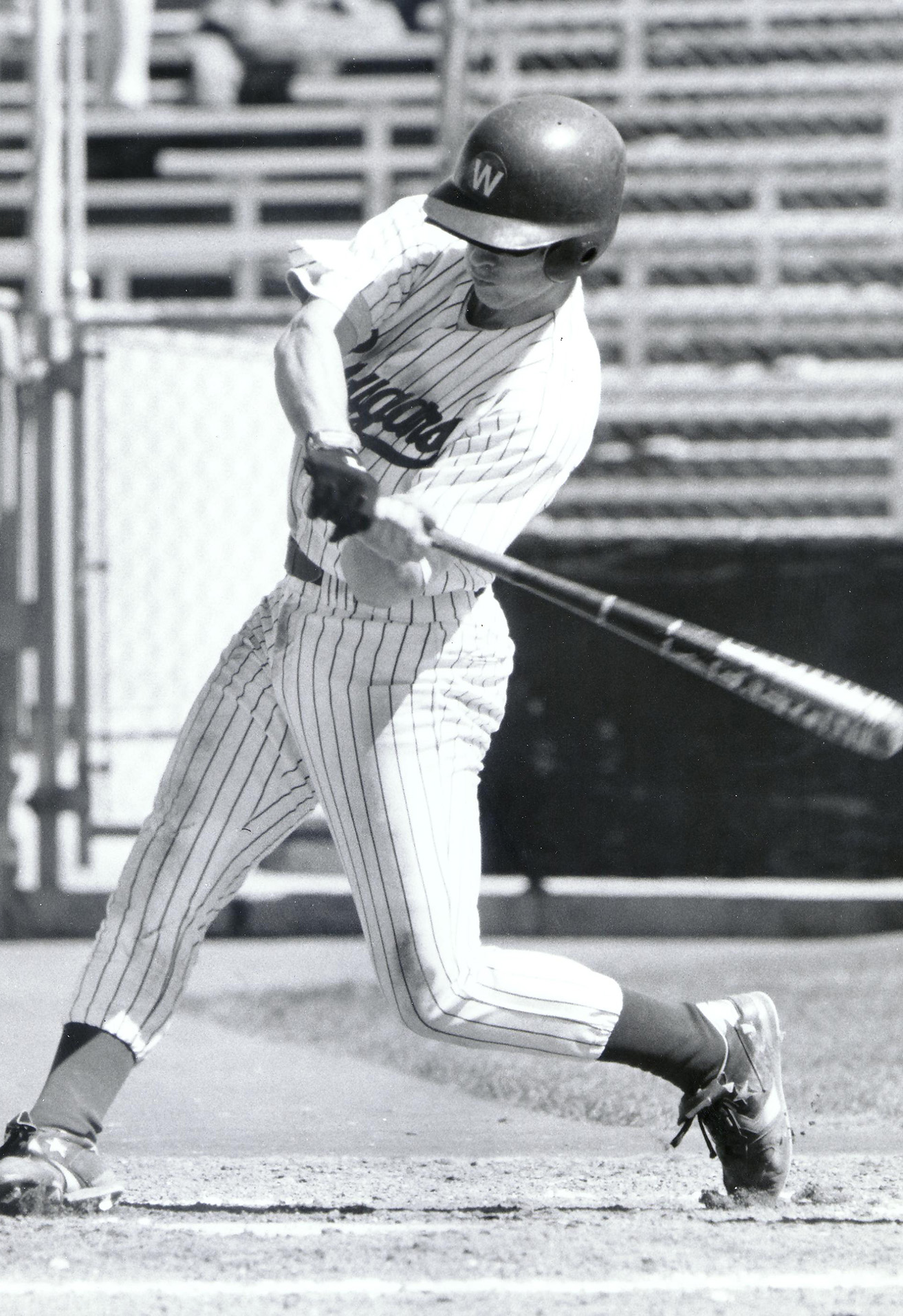 SCOTT HATTEBERG (2015)
Scott Hatteberg spent three seasons (1989-91) in a Cougar uniform before embarking on an 18-year professional career. An All-State baseball player out of Yakima, Wash., it didn’t take long for Hatteberg to make an impact for the Cougars. As a sophomore in 1990 he led the team in hitting (.381), along with hits (88), total bases (145), slugging (.628) and tied a conference record with 29 doubles. He earned first-team All-Pac-10 North honors and was the Region VII Selection Hitter award recipient as Washington State’s everyday catcher, where he formed the battery with another WSU Hall of Famer, Aaron Sele. The summer before his junior season he was selected for Team USA and toured Europe with a Pac-10 All-Star team, where he hit a team-best .467. His junior season he hit .365 with 21 doubles, tied for fifth on WSU’s single-season list and captured Pac-10 North MVP honors, first-team All-Pac-10 accolades for the second-straight season, and was named to the ABCA All-District second team. He was selected No. 43 overall by the Boston Red Sox in the 1992 MLB Draft. He spent 14 seasons in the major leagues, seven with Boston, four with Oakland and three with Cincinnati, retiring in 2008 with career totals of 1,153 hits, 249 runs, 249 doubles, 106 home runs and 527 RBI. He was one of the featured players in the hit movie, Moneyball.
 JUD HEATHCOTE (1990)
When Jud Heathcote guided the 1978-79 Michigan State men’s basketball team to the NCAA championship, few people associated with Washington State were surprised. A Cougar graduate who spent three seasons as a student-athlete playing for Jack Friel, Heathcote earned his coaching credentials as a seven-year assistant under Marv Harshman. His first head coaching job came at Montana, prior to the 1971-72 season. After five seasons in Missoula, Heathcote took over the bench at Michigan State. In 19 years with the Spartans, his teams made nine NCAA Championship appearances and earned three NIT bids. He won over 60 percent of his games and amassed over 400 victories as a collegiate varsity coach. An assistant coach for the United States at the 1975 Pan Am Games, Heathcote is a member of the National Collegiate Basketball Hall of Fame, the State of Washington Sports Hall of Fame, the Inland Northwest Sports Hall of Fame, the Montana Athletic Hall of Fame and the Michigan State Athletic Hall of Fame.
 MEL HEIN (1979)
Mel Hein is widely considered the greatest football player in Washington State history. He played three seasons as a center for the Cougars (1928-30), was named All-West Coast in 1929 and received All-America status the following season as a senior. He was a member of the Cougars’ 1930 team that earned a berth in the Rose Bowl and his No. 7 was the first jersey retired in Washington State history. Hein played in the NFL (1931-45) with the New York Giants, starting at center and linebacker, and was named first or second team All-NFL in 13 of his 15 seasons. He was a member of NFL championship teams in 1934 and 1938 and was the first center in league history to be named MVP when he won the award in 1938. The Giants also retired his No. 7. Following his playing career, Hein was the head coach of the All-America Football Conference’s Los Angeles Dons in 1947 and served as the supervisor of officials for the American Football League and American Football Conference. He is a charter member of the College Football Hall of Fame (1954) and the Pro Football Hall of Fame (1963). In 1969, Hein was named one of the 11-best players of all-time and was the center on the NFL’s 50th Anniversary Team. In 1994, he was a member of the NFL’s 75th Anniversary Team. Five years later, the Sporting News ranked him No. 74 on its list of greatest players of all-time. Hein received the WSU Distinguished Alumnus Award in 1983. He is a member of the State of Washington Sports Hall of Fame and the Inland Northwest Sports Hall of Fame.
 MARK HENDRICKSON (2016)
One of Washington State’s most versatile athletes coming out of Mount Vernon, Wash., Mark Hendrickson played both basketball and baseball for the Cougars in his four-year athletics career (1992-96). On the basketball court, the 6-foot-9 forward made an immediate impact as a freshman during the 1992-93 season, averaging 12.6 points and 8.0 rebounds as he was named to the five-member Pac-10 All-Freshmen Team. Despite his strong start, Hendrickson saved his best for last, as he was a Pac-10 All-Conference First Team pick his junior and senior years. He finished his career as the Pac-10 active leader in double-doubles with 43 in 108 games and became the first Cougar to lead his team in rebounding all four seasons. Hendrickson concluded his basketball career in 1996, holding the school record in career field goal percentage (.567), while ranking second for career rebounds (927) and third for points (1,496). Hendrickson made eight appearances on the mound for the Cougar baseball team during his junior year (1995). Following graduation Hendrickson was the 31st overall pick in the 1996 Draft by the Philadelphia 76ers. After four years in the NBA with four different teams (Philadelphia, Sacramento, New Jersey and Cleveland), he moved on to baseball, where he had been a four-time MLB Draft pick. He spent 10 years in the major leagues, playing with Toronto, Tampa Bay, Los Angeles (Dodgers), Florida and Baltimore, collecting 58 wins and 666 strikeouts before retiring in 2015. Hendrickson is one of 12 athletes all-time to play both in the NBA and MLB, and the only one to play at least four seasons in each league.
 VAUGHAN HITCHCOCK (2006)
Vaughan Hitchcock earned seven varsity letters as a Cougar, three in football and four in wrestling. On the gridiron he was a starter at fullback and guard. On the mat, he captured the 191-pound Pacific Coast Conference wrestling title as both a junior and a senior. He was voted Washington State’s Athlete of the Year in 1956. Hitchcock served as head wrestling coach at Cal Poly (1962-85), compiling a 355-112-4 wrestling dual meet record. Under his tutelage, Cal Poly wrestlers won 20 individual national championships and his teams won eight national titles. A two-time national coach of the year, Hitchcock was the team leader and freestyle coach of Team USA at the 1973 World Championships. He was the team leader and Greco-Roman coach of the 1976 U.S. Olympic Team. Hitchcock is a member of the Helms Amateur Wrestling Hall of Fame, the NCAA Division II Wrestling Hall of Fame, the California Wrestling Hall of Fame and the California Chapter of the National Hall of Fame.
 BABE HOLLINGBERY (1978)
Orin E. “Babe” Hollingbery was the head coach of Washington State football for 17 seasons, 1926-42. During that span, his teams won 62.5 percent of their games, best among Cougar mentors who coached at least five seasons. Hollingbery’s squads were nationally ranked in four of his final-seven seasons (Associated Press rankings began in 1936). Under his guidance, the Cougars were undefeated at home from 1926-34 and participated in the Rose Bowl following a 9-0-0 regular season in 1930. Hollingbery organized the first East-West Shrine Game and was served the all-star event for 45 years, as head coach, and director of coach and athlete selections. He is a member of the College Football Hall of Fame, the State of Washington Sports Hall of Fame and the Inland Northwest Sports Hall of Fame. Washington State’s field house was named in his honor.
 ALBERT "PETE" HOOPER (1984)
Albert “Pete” Hooper played basketball for Washington State, 1937-39. During his three seasons, the Cougars were 66-29. Hooper scored 605 points and ranked sixth on the school’s all-time scoring list at the time. As a sophomore, he was part of WSC’s 1937 Pacific Coast Conference Northern Division championship team. He was an all-conference pick as a junior and All-Northern Division as a senior. In 1939, he batted .351 on the Cougars baseball team. Hooper coached the WSC freshman basketball team in 1940 and 1941.
 BERNARD JACKSON (2013)
Bernard Jackson spent two years in a Cougar uniform (1970-71) and certainly made the most of his time on the Palouse. Arriving out of Pierce Junior College in California, Jackson made an immediate impact. In the 1970 season-opener against Kansas, Jackson rushed for 155 yards and scored three touchdowns. He led WSU that season with seven rushing touchdowns. The 1971 season was even better as Jackson started fast and never slowed down. He rushed for 130 or more yards in five of his first eight games, including a then-school record 261 yards against Oregon. He finished the year with 1,189 yards and 11 touchdowns, both school records at the time. In all, Jackson set 11 school records, was named to every major West Coast All-Star team and received invitations to play in the East-West Shrine Game, Hula Bowl and Coaches’ All-America Game. A fourth-round pick of the Cincinnati Bengals in the 1972 NFL Draft, Jackson played five years in Cincinnati, three in Denver as part of the famed “Orange Crush” defense, before closing out his career in San Diego.
 SAM JANKOVICH (2006)
Sam Jankovich joined Jim Sweeney’s Washington State football staff in 1968. After four seasons, he was named Cougar Athletic Director Ray Nagel’s assistant, overseeing the Cougar Club. Jankovich doubled the organization’s membership and tripled funding in four years before becoming Nagel’s successor in July, 1976. Jankovich left an indelible mark on Cougar Athletics, undertaking the monumental project to increase the Martin Stadium capacity by over 10,000 from the 27,500 it seated at the time. His forward looking facility improvements, including the lowering of the stadium floor 14 feet and the reworking of Washington State’s football schedule, allowed the Cougars to play key games in Pullman and impacted future football successes for many years. He championed the creation of the WSU Athletic Hall of Fame in 1978, pushed for other facility improvements and expanded staff areas focusing on student support. In 1984 Jankovich was named athletic director at Miami (Fla.). He later served as the general manager of the NFL’s New England Patriots.
 ELDON JENNE (1978)
Washington State University's first Olympic Games representative. Jenne made the U.S. team in the pole vault in 1920 and participated in the Games at Antwerp, Belgium, after completing his junior year at the university. He won Pacific Coast pole vault titles in 1919, 1920 and 1921, earned four Varsity letters in track at WSU and also participated in baseball. A native of Coupeville, he entered WSU from Mount Vernon High School. Had a distinguished career as teacher, coach and administrator in athletic and recreation programs in the state of Oregon. Retired in San Diego, Calif.
 BRIAN KELLY (1989)
Few people realized when Brian Robert Kelly graduated from WSU in 1978 his best football days were ahead, that he would become one of the great receivers in Canadian Football League history. When he finished his career at WSU following the 1977 season, the 5-9 Arcadia (Calif.) native ranked fourth on the all-time reception list with 116 catches and third in yardage with 1,792 yards. He wore number 44, caught 44 passes as a junior and scored 44 points, then caught 44 again as a senior. Kelly won the J. Fred Bohler Award for inspiration as a senior, and is best remembered for a pair of touchdown catches at Nebraska in WSU's 1977 upset. Following his WSU career, Kelly signed on as a free agent with Edmonton of the CFL. He didn't play in 1978 because of an ankle injury, but Edmonton coach and WSU graduate Hugh Campbell signed him to anther contract. In the next nine years, before his retirement in 1987, Kelly rewrote the team and CFL record book. He caught 575 career passes for 11,169 yards and 97 touchdowns. He set CFL records for reception yardage and touchdown receptions and also established, among others, these CFL records: touchdown receptions in 71 games, six 1000-yard seasons and 41 100-yard games. Kelly continues to live in Edmonton, where he owns a Hyundia dealership.
 ALLAN KENNEDY (2015)
Allan Kennedy was a two-time All-America offensive lineman for the Cougars and later helped the San Francisco 49ers win two Super Bowls. The Woodland Hills, Calif., native attended Washington State from 1976-80 and was a four-year starter while playing for three different head coaches: Jackie Sherrill, Warren Powers and Jim Walden. Known as “Big Al” because he was one of the Cougars first “big” offensive lineman, the 6-7, 275-pound Kennedy was a legendary team leader. Kennedy began his WSU career in 1976, starting as a true freshman and emerged as one of the elite lineman in the country in 1979, earning All-American honorable mention, All-West Coach and All-Pacific-10 Conference First Team honors at right tackle. As a senior in 1980, Kennedy was named a team captain, earned first-team All-America honors and was selected to play in the 1981 Japan Bowl All-Star Game. Kennedy, who earned his bachelor’s degree in criminal justice, was taken in the tenth round of the 1981 NFL Draft by the Washington Redskins and later played five seasons in San Francisco, helping the 49ers win a pair of Super Bowls in the 1981 and 1984 seasons before he retired in 1986.
 BOB KENNEDY (1988)
Robert Kennedy, who rewrote just about every rushing record listed in the WSU record book during his career in the early 1940's, has the distinction of having played in two East-West Shrine Games. Kennedy completed his illustrious career as a Cougar fullback by playing in the 1943 East-West Shrine game, then came back two years later to make a repeat performance representing March Field Air Force Base. The Sandpoint (Idaho) High graduate started at WSU in 1939 and during his three varsity seasons rushed for 1217 yards on 343 carries, scored 18 touchdowns, including 15 by rushing, and scored 111 points, all Cougar career marks. He capped a brilliant senior season with his selection to the United Press International first All-America team and to Associated Press's All-West Coast first team and All-America second team. Kennedy's single season records included 813 yards rushing, 11 touchdowns and 69 points. His 171 yards rushing against Montana, including an 81-yarder, were single game marks. After World War II, Kennedy played professional football with the New York Yankees of the American Football Conference from 1946 through 1950. He is now semi-retired in Scottsdale, Arizona after a successful land developing career.
 KERI KILLEBREW (2009)
To say Keri Killebrew was a trend setter at Washington State may indeed be an understatement. Her list of accomplishments reads like "Who's Who of College volleyball," which she was. After transferring from Weber State and sitting out the 1989 season, she burst onto the Cougar scene and over the next three years set numerous WSU match, season and career records. During her junior season, she led the Cougars to their first-ever NCAA Championship tournament appearance while ranking seventh nationally in assists. Her finale came as a senior in 1992 when she became WSU's first player to receive All-America status. She again led WSU into postseason, where the Cougars captured the National Invitational Volleyball Championship while becoming the first school in tournament history to sweep through the tournament without losing a game - victorious in 18 straight games. The NIVC Championship MVP winner concluded her career with 5,848 assists, the eighth-best mark in NCAA D-I history. Her three-year WSU total was a school record 4,553 assists. Killebrew coached in the college ranks for several years, then moved into the real estate business in Milwaukee, Wis.
 JOSHUA KIMETO (2015)
Joshua Kimeto arrived at Washington State University with solid credentials. As a member of the Kenyan National Team he was a two-time national cross country champion in his native country. In his first semester in Pullman, Kimeto won the 1975 Pacific-8 Conference Cross Country Championship, earning Pac-8 Runner of the Year honors as a freshman. His running style of looking at the ground during an entire race was soon rectified with glasses. The bespectacled Kimeto may have looked more like a scholar than a gutsy run-until-you-drop distance standout but his opponents soon learned the truth. Kimeto won back-to-back NCAA 5000m titles, winning the championships in 1976 and 1977. During his WSU career, Kimeto garnered eight All-America certificates. In 1976, Kimeto achieved collegiate records in the 2000m (5:03.7), 3000m (7:37.5), 2-mile (8:10.8), and 4000m (10:11.6). At the time of his Hall of Fame induction, Kimeto’s times remained second-best in the WSU 3000m records, sixth-best in the 5000m, and fourth-best in the 10,000m.
 SAMSON KIMOMBWA (2012)
Samson Kimombwa is a prominent member of the Long Crimson Line: the list of highly accomplished distance runners at WSU that began in the 1970s and either won a Pac-10 and/or NCAA title or scored team points in an NCAA Championships in the 1500m to 10,000m races. Kimombwa, from Kitale, Kenya, earned four varsity letters in both cross country and track at WSU, and accumulated nine All-America certificates along the way. During the 1975-76 school year, his first in Pullman, Kimombwa set the national freshman records for the indoor three-mile (13:23.5), the indoor 5,000m (13:59.8), and the 21k run (1:07:35.6). During the summer of 1977 he ran a total of eight sub-28:30 times for the 10,000m, including two races under 27:40. Most impressive was his 10k time of 27:31.47, a World Record mark, run at the World Games in Helsinki. Kimombwa’s WSU, collegiate and World record time was broken the following year by teammate and fellow Cougar Kenyan Henry Rono. Teammates Rono and Joel Cheruiyot provided Kimombwa with the most competition and the trio are still one-two-three in the school’s all-time 10k list. Kimombwa finished ninth in the balloting for Track & Field News’ 1977 Track and Field Athlete-of-the-Year, and his world record performance that year placed him fourth in the balloting for the best single performance of the year. In Pac-8/10 competition, he won three titles and finished in the top five nine times, while in NCAA competition won one title and finished in the top five eight times.
 MIKE KINKADE (2017)
One of the finest baseball players ever to pass through Washington State, Mike Kinkade left an indelible mark on the history of Cougar baseball during his time. Recruited by and playing his first three seasons under the legendary Bobo Brayton, Kinkade set WSU records for career hits (304), runs (230) and doubles (75) during his career. Starting 224 of 228 games, he also finished second on WSU’s all-time lists for games played (228), RBI (197) and at-bats (844), third in triples (12) and walks (125), fifth in batting average (.360) and eighth in home runs (25). For the three-time team captain, his junior season was arguably his finest as he earned All-America second-team honors by National Collegiate Baseball Writers and third-team honors by both Collegiate Baseball and Baseball America after hitting a career-best .388, with 90 hits, a school and Pac-10 North-record 31 doubles, nine home runs and 61 RBI. He was a three-time All-Pac-10 Northern Division First-Team selection, twice as a DH (1993, 1994) and as a catcher (1995), before being drafted in the ninth round of the 1995 MLB June Amateur Draft. Kinkade played six major league seasons, parts of three with the New York Mets, two with the Los Angeles Dodgers and two with the Baltimore Orioles, finishing with a career batting average of .256 with 100 hits, 20 doubles and 10 home runs. He also earned a Gold Medal as a member of the U.S. Olympic Team at the 2000 Sydney Games.
 PETER KOECH (2009)
The Long Crimson Line includes some of the world's greatest distance runners of all time, including world record holder Peter Koech, who was one of the dominant collegians of his era before graduating from WSU in 1986 with a social science degree. When he concluded his career, Koech had earned 11 All-America certificates, captured five Pacific-10 Conference crowns and two NCAA Championships. His conference titles include three wins at 10,000 meters, one at 5,000m and a fifth at 1,500m which came in 1985 and was a rare feat as he doubled with a win in the 10,000m at the same meet. In 1984 he won his first NCAA title, a 3,000m victory, and then in 1985 he concluded his Cougar career by winning the NCAA steeplechase, a relatively new event for the talented Kenyan runner. In 1988 Koech captured the Silver Medal in the steeplechase at the Seoul Olympic Games, only to come back a year later to establish the event's World Record in a time of 8:05.35, bettering the second oldest track record in the record book and taking the steeple title away from Cougar great Henry Rono. Koech and his family now live in Albuquerque, New Mexico.
 JULIUS KORIR (2004)
One of WSU's most honored distance runners, Julius Korir captured the 1984 Olympic Gold Medal in the steeplechase and went on to become one of the greatest distance runners in Cougar history. Korir first stepped foot on the WSU campus in the winter of 1983 and immediately made a statement, capturing the Pacific-10 Conference steeple title as a freshman and was runner-up at the NCAA meet in the steeple and fifth over 5,000 meters. In the spring of 1984 Korir won every steeple race he entered until the final of the NCAA meet, where he finished second. He had even greater success that season in the 5,000m, winning every collegiate race, including the Pac-10 and NCAA titles. Later in the summer, at the Olympic Games in Los Angeles, Korir blitzed the steeple field in taking home Kenya's only Gold Medal. His winning time in the final ranked him second on the WSU, Pac-10 and collegiate list behind former Cougar and countryman Henry Rono. Korir attended Kaptumo Secondary School in Kapsabet, Kenya.
 BERNARD (Kip) LAGAT (2009)
Bernard “Kip” Lagat dominated Pacific-10 Conference middle distance running in the mid-1990’s and ended his Cougar career among WSU’s all-time greats. From 1997-1999 he won 11 championship races against Pac-10 and Mountain Pacific Sports Federation competition, including a historic three titles over 800m, the mile and 3,000m at the 1999 MPSF meet. He won that meet’s MVP honors three times and the Pac-10 outdoor meet MVP title once. At the NCAA level, Lagat earned 11 NCAA All-America certificates and was MVP of the 1999 NCAA Indoor Championships with wins in the mile and 3,000m. Also included in his resume are four NCAA titles, including a world record in 1998 indoor meet as a member of the distance medley relay team. Lagat’s success continues today with his ranking as one of the world’s best. He has silver and bronze Olympic Games medals to his credit, six world titles, including a historic 1,500m-5,000m double at the 2007 World Championships, and multiple American records. The 2000 WSU graduate with a two degrees (management information systems and decision science/econometrics), became an American citizen in 2004.
 LAURA LAVINE (2006)
Laura Lavine left an indelible mark during her four years at Washington State. She arrived in Pullman as a two-time state discus champion (1983 and 1984) from Issaquah High School.. As a Cougar, Lavine placed fifth in the discus at the 1986 NCAA Championships, earning her first of three All-America honors. In 1987, she won the first of two Pac-10 discus titles and became WSU’s first woman NCAA Outdoor Track & Field champion. Lavine proved her first national title wasn’t a fluke by repeating as the NCAA discus champion the following year, clinching the title with her clutch final throw of the 1988 competition. Lavine’s lifetime-best discus throw of 189-feet, 8 inches, tossed June 11, 1988, in Tucson, Ariz., still stands as the school record. After earning four letters as a discus and shot put thrower, Lavine continued competing, placing seventh in the discus at the 1988 US Olympic Trials and competing at the 1992 Olympic Trials. In 1996, Lavine was selected WSU’s Woman Athlete of the Decade as part of the Pac-10’s celebration of 10 years of women’s athletics.
 CURT LEDFORD (2015)
Curt Ledford was a 220-yard All-American sprinter and world record relay member while at Washington State College from 1937-39. At the 1937 NCAA Championships, Ledford finished fourth in the 220-yard dash. He set the school record in 1938 for the 220-yard race when run on a straightaway. He led WSC to the 1939 Northern Division Championship when he won the 100-yard dash, the 220-yard dash and anchored the sprint relay team to a second consecutive victory, scoring 11 1/4 points for the Cougars. Ledford captured the 220-yard title at the 1939 Pacific Coast Conference Championships, and went on to be the runner-up at the NCAA meet where he also took fifth in the 100-yard dash. While the Vancouver, Wash., native found success in individual races, he found fame as a member of a 440-yard relay team. Ledford ran the third leg of the sprint relay at the PCC versus Big Ten All-Stars meet, June 26, 1937, in Los Angeles. Stanford’s Jack Weiershauser and USC’s George Boone were joined by Cougars Lee Orr and Ledford to win the short relay in a time of 40.7 seconds which tied the world record run by USC in 1936.
 MIKE LEVENSELLER (1993)
Few records stand the test of time and those that do and those who set them are to be cherished. Such is the case with Washington State's Mike Levenseller. As a wide receiver Levenseller set records during his playing days that stood for many years. A product of Tacoma's Curtis High, Levenseller rocketed into prominence in 1976 when he caught 67 passes for 1,124 yards. No receiver in Cougar history had ever caught more passes in a single season. In addition, his reception yardage of 1,124 yards ranked as the most by any receiver to play in the Pacific-10 Conference (not including bowl games). A year later with 43 receptions he pushed his career total to 121 passes caught for 2,061 yards and 10 touchdowns. Levenseller is the third member of the Cougars' vaunted pitch and catch combo of the mid-1970's to be inducted into the hall of fame. The quarterback in those record-setting days was Jack Thompson (1987 inductee) and his chief targets were Levenseller and Brian Kelly (1989 inductee). Selected to several All-America, All-West Coast and All-Pac-8 Conference teams following the 1976 and 1977 seasons, Levenseller went on to play in the 1978 Challenge Bowl and Hula Bowl all-star games. Drafted by the Oakland Raiders in the sixth round of the 1978 National Football League draft, Levenseller spent eight years in the NFL and Canadian Football League, then turned to coaching. During his CFL coaching tenure, Levenseller tutored receivers for the British Columbia Lions and Toronto Argonauts, before returning to his alma mater as wide receiver coach in 1992.
KEITH LINCOLN (1979)
Keith Lincoln - the "Moose of the Palouse" - may be remembered best by football fans across the nation as the Golden Boy of the San Diego Chargers in the early 1960's, but Cougar fans will never forget the great triple-threat back of the 1958-60 teams at WSU. Lincoln ran, passed and kicked for Coach Jim Sutherland's Cougars, setting a school career rushing record (1,501 yards), a single season punting average record (43.4 in 1959), and a career punting average record (40.3). Lincoln was an All-West Coast selection at halfback in 1959, a season in which he rushed for 670 yards, caught 11 passes for 182 yards and scored five touchdowns. He capped that season by playing in four postseason all-star games. A two-time American Football League all-star, he was the MVP in the ALF championship game in 1963 and MVP of the AFL All-Star game following the '63 season. A member of the San Diego Chargers, State of Washington and Inland Northwest Sports Halls of Fame, he was named to the Chargers’ 40th Anniversary All-Time Team and WSU’s all-time Cougar team to commemorate the 100th anniversary of WSU football in 1995. Lincoln returned to Pullman following his playing career and served as the executive director of WSU’s alumni association for more than 25 years.
PAUL LINDEMANN (1980)
As a 6-foot-7 center for the Cougars, Paul Lindemann won All-America honors on the Cougar team that won the Northern Division, Pacific Coast and Western Regional NCAA titles and finished second in the NCAA finals under coach Jack Friel in 1941. He was the second-leading scorer for WSU in the decade of the 30s with 668 points. Lindemann also earned All-Coast and All-Northern Division honors during the '41 season and was inducted into the State of Washington Sports Hall of Fame in 1994 and the Pac-10 Hall of Honor in 2010. He joined Phillips Petroleum after leaving WSU and played on four national championship teams with the AAU 66'ers. His teams were 176-25 during those five years and he was an AAU All-America selection in 1945. Following his playing career he worked for Phillips Petroleum as manager of Corporate Safety in Bartlesville, Okla., and received the National Safety Council's Citation for Distinguished Service in 1979.
GERRY LINDGREN (1978)
Gerry Lindgren is considered by many the greatest distance runner in American collegiate history. He won 11 straight NCAA titles while at WSU resulting in11 All-America awards. Lindgren set 57 American Records from two to six miles and shared a world record with Billy Mills for the 6-mile with a time of 27:11.6. While a student at John Rogers High School in Spokane, Lindgren set 11 prep distance marks, and won a spot on the 1964 U.S. Olympic team for the Games at Tokyo. He placed ninth in men's 10,000 meters at 1964 Olympic Games and was the 1967 USA 3,000m champion and the 1964 USA 10,000m champion. During his time as a high school cross country and track star in the early 1960s, Lindgren set eight world high school records, among the most impressive was a 13:44, 5,000 meter run, a mark that stood for 40 years. He was the first American to beat the Russians in a distance race, accomplishing this feat at Los Angeles in 1964 in the U.S./Russia dual meet in the 10,000 meters. Lindgren is a member of the USA Track & Field, the Inland Northwest and State of Washington Sports Halls of Fame.
RIEN LONG (2013)
Rien Long played three years in a Cougar uniform (1999-2002) and as the cliché goes, saved his best for last. Long’s 2002 performance, in which he helped WSU to a 10-3 record and a Rose Bowl appearance against Oklahoma, rivaled any season by a Cougar defensive lineman as he posted 13 sacks and 20 1/2 tackles-for-loss, both figures ranking in the top four nationally, and in WSU’s single-season record books. Though he capped the season by being named to the Football Writers Association of America All-America First Team and the Outland Trophy winner as the nation’s top interior lineman, Long may be best remembered for his overtime performance where he had a sack and two tackles-for-loss on USC’s only possession in a 30-27 WSU victory. For his career Long played 33 games, collected 17 sacks and 35 1/2 tackles-for-loss which ranked fifth and third on WSU’s career lists, respectively. Selected in the fourth round of the 2003 NFL Draft, Long played in 39 games over three seasons with the Tennessee Titans before injuries cut his career short.
DUBI LUFI (1989)
Dubi Lufi can, without question, be called the greatest gymnast to ever compete for WSU. The native of Israel completed his WSU education in three years and one semester, earned Phi Beta Kappa honors with a 3.5 grade point average and earned All-America status as a junior and senior. He is the Cougars' only All-American in gymnastics while earning his bachelor's degree from WSU in 1975, a master's from Idaho a year later and his PhD from WSU in 1978. As a senior, Lufi was WSU's conference medal winner as the top scholar-athlete. In the fall of 1983 Lufi had to return home for the Six-Day War. He returned in February after traveling 30 hours, registered and competed against Washington, leading WSU to its first win over the Huskies in 10 years. Lufi was a member of Israel's Olympic team in 1976 and 1980, competed six times in the World Games, won all-around national titles in 1968-69-70-71-81, and in 1984 retired as the oldest (35) competing gymnast in international competition. He served as Israel's National Technical Director for Gymnastics and was head coach of Israel's most successful junior team. He also served as clinical psychologist at a regional mental health center and specialized in work with adolescents and family problems.
DAN LYNCH (2006)
A four-year letter winner at Washington State, Dan Lynch quickly moved up the Cougar ranks. As a redshirt junior, Lynch started all 11 games for the Cougars and helped to anchor an offensive line that boosted WSU to second in rushing among Pac-10 teams. In his final season, Lynch was a unanimous selection to the All-Pac-10 first team for two consecutive seasons and the unanimous recipient of the Pac-10 Morris Trophy winner for his work as an offensive lineman. Lynch earned his bachelor's degree in business administration from WSU and was named the Outstanding Senior of the Year in 1984. In the early 1990s, Lynch settled in the Czech Republic and has worked with numerous companies all over Eastern Europe. In 2004, he was awarded the "Golden Egg Award" as philanthropist of the year for his work with local Czech charities and children's organizations. Since 2000, Lynch has been with 3TS Capital Partners, a central European private equity fund, where he is currently the managing partner and direct coordinator for investment structuring, negotiations and syndicated transactions.
KIM LYNASS (2012)
Kim Lynass is the best student-athlete in Washington State soccer history. The Spokane native lettered from 1990-93 and left WSU holding more than 20 school records. Lynass set an NCAA record by scoring a goal in nine-straight matches over the 1990-91 seasons. Her 30 goals and 1.50 goals per game as a freshman ranked third and fourth, respectively in the NCAA record book at the time. She finished her career ranked in the NCAA top 10 for goals, goals per game and points per game. Two decades after leaving Pullman, Lynass still held the top four spots on the Cougars’ single-season goal list. Of her 83-career goals, 23 of them were game-winners. She scored two or more goals in a match 22 times, including four matches with four goals. Lynass was named NCAA Far West All-America First Team (1993), Pac-10 All-Academic (1993) and a Pac-10 Medal Winner in 1993, Northwest Collegiate Soccer Conference Player of the Year (1991) and two-time All-Northwest Collegiate Soccer Conference First Team (1990-91).
DAN LYNCH (2006)
A four-year letter winner at Washington State, Dan Lynch quickly moved up the Cougar ranks. As a redshirt junior, Lynch started all 11 games for the Cougars and helped to anchor an offensive line that boosted WSU to second in rushing among Pac-10 teams. In his final season, Lynch was selected to the All-Pac-10 first team for the second consecutive season and the unanimous recipient of the Pac-10 Morris Trophy winner for his work as an offensive lineman. He was named First Team All-America by the Associated Press and Football News, while garnering second-team honors by The Sporting News. Lynch earned his bachelor’s degree in business administration from WSU and was named the Outstanding Senior of the Year in 1984, along with being named the Frank Butler Award winner for Cougar spirit. He capped his senior season by participating in the East-West Shrine Game and the Senior Bowl. In the early 1990s, Lynch settled in the Czech Republic and has worked with numerous companies all over Eastern Europe. In 2004, he was awarded the “Golden Egg Award” as philanthropist of the year for his work with local Czech charities and children’s organizations.
CHRIS MARKER (1986)
A native of Vista, Calif., Chris Marker was an All-American swimmer for the Cougars in 1964, his senior season. Marker set numerous WSU records during his time in Pullman with two of those coming in 1963 when he won the 100 and 200-yard freestyle events at the Pacific-8 Conference Championships. Later that season he placed in the 100 and 200 at the NCAA Championships and was first alternate for the USA team at the 1963 Pan-Am Games. In 1964 he was fourth in the 100 and 200-yard freestyle events and sixth in the 50-yard freestyle at the NCAA championships after sweeping all three events at the Pac-8 championships. His fourth-place finishes at the NCAA Championships that year marked the highest by a Cougar swimmer in school history. Marker’s academic achievements at WSU matched his performance in athletics. He was named to Crimson Circle scholastic honorary, Beta Gamma Sigma, business major’s scholarship honorary and Sigma Iota, hotel administration honorary. Marker received WSU’s conference student-athlete award for 1964 and was chosen Greek Man of the Year at WSU. After leaving WSU he received international recognition in the hospitality industry
FRANK MATAYA (1989)
To call Frank Mataya versatile during his WSU career is an understatement. From his enrollment in 1946 until graduation in 1951, with a physical education degree, the Roslyn native earned 13 varsity letters in four sports. Mataya was a left-handed quarterback and defensive specialist on the gridiron for coach Phil Sarboe. He played basketball for coach Jack Friel for three years, 1949-50-51. During the spring each year, Mataya was a mainstay for Jack Mooberry's track team, competing in the shot put (he was the state high school record holder), discus and javelin. He captured third in the discus at the Northern Division Championships one year, won the shot put title as a sophomore and a year later took fifth at the Pacific Coast Conference meet. Baseball entered the picture in 1951 when he joined Buck Bailey's team and hit .333, the third best average on the team. Mataya coached one year at Entiat High, then four years at Cle Elum, his high school alma mater. In 1959 his basketball team won the state title. In 1960 he began a long association with Wenatchee Valley College. He served as head football coach in 1960, had a 15-year reign as track coach and also served as head basketball coach for many years. He also wore the athletic director's hat for several years. In 1985 he retired from teaching and coaching duties.
RUEBEN MAYES (1993)
Rueben Mayes was once described by his Washington State University football coach as a "playful colt." Perhaps Jim Walden knew then, in 1982, that Mayes would soon be considered a stallion among collegiate running backs. By the end of his distinguished four-year Cougar career Mayes held numerous WSU rushing records and several Pacific-10 Conference and NCAA marks. Twice Mayes was honored by the Pac-10 coaches as the conference's outstanding offensive player of the year. As a junior Mayes burst onto the national scene in 1984 to finish 10th in the Heisman Trophy balloting. In back-to-back games he rushed for 216 yards at Stanford, including five touchdowns, and then an NCAA, Pac-10 and WSU record 357 yards at Oregon. His two-game total of 573 yards also set NCAA, Pac-10 and WSU records. The Stanford game is one of the most memorable in Cougar history. Mayes earned numerous All-America honors his final two seasons at WSU and in the process set more than a dozen records, including 3,519 rushing yards, 23 career touchdowns rushing and 26 in all, 13 games with more than 100 yards rushing, and 4,418 all-purpose yards. The North Battleford, Saskatchewan, Canada native was the 1985 recipient of the Harry Jerome Award, given each year to black leaders in Canada as recognition for their contributions in athletics, community service, academics and creative arts. From WSU Mayes went on to star in the National Football League. Drafted by the New Orleans Saints in the third round in 1986, he was selected to the Pro Bowl in 1986 and 1987 and was the NFL Rookie of the Year after gaining 1,353 yards his first season. His professional totals included 866 carries for 3,484 yards and 23 touchdowns in seven seasons, the final two in Seattle. Mayes, who earned his master’s in business administration from WSU in 2000, was inducted into the College Football Hall of Fame in 2008.
ERIN McCLEAVE (2015)
A native of Rutherglen, Australia, Erin McCleave is as one of the most decorated Cougars in Washington State swimming history. A freestyle specialist, McCleave dominated every distance from the 100 to 1650 freestyle, finishing her career with school records in the 100, 200, 500, 1000, and 1650 freestyle events, in addition to a pair of records in the 400 medley and 800 freestyle relays. As a junior, McCleave qualified for the 2006 NCAA Championships in the 200, 500, and 1650 freestyle events, setting a school record with an 11th place finish in the 1650 free. McCleave returned to the national championships as a senior, where she finished 10th in the 1650 freestyle, breaking her own school record. McCleave became the first swimmer in Cougar history to earn Honorable Mention All-American honors and was the first WSU swimmer to be named national collegiate swimmer of the week and Pacific-10 Conference Swimmer of the Month. A three-time All-American, McCleave was nominated as NCAA Woman of the Year in 2007. After graduating, McCleave went on to represent Australia at the 2007 World University Games where she placed ninth in the 1500 freestyle. In 2008, McCleave took gold in the 1500 freestyle at the Australian National Swimming Championships.
ROBERT McGUIRE (2012)
Robert Charles McGuire was born Dec. 2, 1927. He attended Lincoln High School in Tacoma, Wash. McGuire was a three-time all-conference selection as an outfielder. He was selected to the 1950 NCAA All-District team while leading Washington State to a national runner-up finish. While overall statistics are not available for McGuire's time at Washington State, he batted .304, .377 and .364 for a career average of .353 in conference play. McGuire played four seasons in Minor League Baseball where he batted .265. He also played halfback for the Cougar football team (1947-49) and was inducted into the Tacoma-Pierce Sports Hall of Fame in 1971.
JOE McINTOSH (1987)
Few pitchers ever achieve the success Joe McIntosh enjoyed during a brilliant Cougar career, either on the field, or in the classroom. The Billings, Montana native came out of Billings High in 1969 known as an infielder, but Cougar coach Bobo Brayton saw the makings of a great pitcher his first year on campus and quickly sent him to the mound. In the next three years McIntosh established nine career records and six Pacific-8 Conference marks, plus a host of other records. In addition, the pre-med major was picked to the CoSIDA Academic All-America first team three straight years. He received his Master of Law (L.L.M.) degree in tax from New York University in 1981 and is now a lawyer in Seattle. The 6-2 right hander won all 10 games as a sophomore in 1971, winning the first of three straight Buck Bailey Awards as WSU's top pitcher. He posted a 10-5 mark in 1972, then finished off his career with a 13-3 mark in 1973. He tossed back to back no-hitters that season six days apart, beating Whitworth 8-0 and then Puget Sound 6-0. McIntosh was a member of the USA team that competed in the World Amateur Tournament in the fall of 1972, striking out 21 in 21.1 innings. He shut out Germany, Brazil and El Salvador for a 3-0 mark. Drafted in the 13th round by San Diego, McIntosh's pro career was cut short by an arm injury after being traded to Houston in 1975.
ED McKINNON (1978)
Ranked by Coach Ike Deeter as the finest WSU boxer in the 40 years Deeter was associated with the Cougar program. McKinnon was the National 155-pound champion in 1937 and was Pacific Coast middleweight titlist in both 1935 and 1937. Won the Far Western Diamond Belt Championship at Portland, Ore., in 1935 and 1936, was Pacific Coast AAU middleweight champion in 1936 and won the Post Intelligencer (Seattle) Golden Gloves title two years. Died in 1963 following a logging accident.ART McLARNEY (1982)
Art McLarney starred in basketball and baseball for the Cougars from 1930-32 and was WSU's first player to reach the major leagues. On the diamond McLarney played shortstop for WSC and signed a professional baseball contract with the New York Giants after his senior season. That year he reached the major leagues, playing nine games with the Giants. On the basketball court he was an All-Pacific Coast choice in 1930 and two-time All-Northern Division selection. McLarney was a student leader as well as an outstanding athlete and served as WSC’s Student Body President in 1932. Following his playing career McLarney was a successful high school and collegiate basketball and baseball coach.CHRIS MARKER (1986)
An All-America swimmer for the Cougars in 1964, he set numerous WSU records, many of which still stand...he was first alternate in 1963 for the USA team to the Pan-Am Games...won two conference titles in 1963 and was in the top ten in two NCAA events...he was fourth in the 100 and 200-yard freestyle events and sixth in the 50-yard freestyle at the NCAA championships in 1964..."Greek Man-of-the-Year" at WSU in 1964...member of Crimson Circle scholastic honorary...currently vice-president for operations of WESTIN Hotel Company...born 10-24-42 in Iowa City, Iowa...attended Vista (Calif.) High.
BUTCH MEEKER (1978)
The legacy of Herbert “Butch” Meeker continues to live on the WSU campus long after his days in Pullman. Despite his diminutive size, 5-foot-5 and 150 pounds, Meeker was an all-conference first team selection at quarterback for the Cougars in 1925 and was picked to play in the 1927 East-West game at the conclusion of a fantastic career at WSU. He set season and career field records as a drop-kicker and was an outstanding broken field runner. Cougar mascots were named for him. When Governor Roland H. Hartley presented the students of WSC a live cougar mascot at halftime of the 1927 Homecoming football game, he suggested the name “Butch,” in honor of the WSU football hero of the day. The students quickly adopted the name, which remains to this day. Meeker was active in student affairs and served as vice president of the student body. Following his time in Pullman Meeker played professional football for two seasons with the Providence Steamrollers.
JACK MELSON (2011)
Jack Melson etched his name as one of the greats of Cougar boxing during his time in Pullman. A Seattle native who attended Seattle Prep, Melson immediately made an impact on the nationally renowned Cougar boxing program as he captured the Pacific Coast Intercollegiate title at 130 pounds as a freshman in 1947. The next year he repeated as the PCI champion, only this time it came in the 127-pound division, followed by another title in 1949 at 125 pounds. Melson capped his Cougar career with a fourth-straight title in 1951, the only boxer in Cougar history with four PCI championships. His first NCAA title came shortly thereafter as Melson became just the fourth Cougar to win an NCAA boxing title, capturing the 130-pound division.
KEITH MILLARD (2015)
Keith Millard was a member of the Washington State Cougar football team from 1980-83 and left his mark as one of the best defensive players ever to wear the uniform. Millard arrived as a tight end and after switching to defense as a sophomore, developed into one of the premiere defensive players in the country. He earned All-Pacific-10 Conference honorable mention honors as a junior while his final campaign for the Cougars saw him tally 84 tackles including 12.5 sacks, earning All-American honorable mention and first-team All-Pac-10 honors after being presented the Morris Award, given to the top Pac-10 defensive lineman. Millard earned trips to the Senior Bowl and the East-West Shrine Game before being named one of the top three defensive tackles in the country by Sporting News. Millard was drafted in the first round of the 1984 USFL Draft by the Arizona Wranglers and also in the first round by the Minnesota Vikings in the NFL Draft that same year. Millard elected to play the 1984 season in the USFL for the Jacksonville Bulls, then spent seven seasons with the Vikings, earning NFL Defensive Player of the Year honors in 1989 after posting a league-best 18 sacks. Millard played nine seasons in the NFL, tallying 58 career sacks, earned two trips to the Pro Bowl, and was named to the All-Pro first team twice before moving on to a successful coaching career.
MARCIA MILES (2017)
Marcia Miles came to Washington State in the fall of 1982 and immediately proved herself as one of the hardest working Cougars’ to grace the hardwood. She earned two First Team All-Northern Pacific Athletic Conference awards during her career while earning Women’s Basketball New Service All-America honorable mention recognition in 1985. As a senior, Miles took home WSU’s Outstanding Female award for her all-around excellence. One of the best scorers to ever put on a WSU uniform, Miles etched her name in the Cougars record books for scoring in a career when she became WSU’s fourth player to reach 1,000 points in her career. She finished her illustrious career with 1,485 points while averaging 15.0 point per game, both marks which ranked second all-time upon her graduation. She finished her career with three of the top-four scoring seasons in WSU history at the time, including posting 483 points during her senior season, which ranked second. She did much of her damage at the free-throw line where she hit 78.9 percent of her attempts, setting the Cougars’ all-time record at the time.
JAY MILLER (2015)
Jay Miller was a four-year letterwinner for the Cougar baseball team from 2002-06, ending his career as Washington State’s all-time hits leader. Miller, from Bellevue, Wash., made an immediate impact, leading WSU in batting average (.341), hits (72) and doubles (21) en route to All-Pacific-10 Conference honorable mention honors. Miller continued his assault on the Cougar record book, leading the team in batting average and hits three of his four seasons. He saved his best for last, earning third-team All-America and first-team Pac-10 honors as a senior. That season he batted .361, sixth in the Pac-10, and led the conference in hits (88) and doubles (28), the latter total second in the NCAA. He finished his career as WSU’s career hits leader with 307. That total placed him ninth all-time in the Pac-10, while his 74 career doubles were second all-time at WSU and the fifth-most in Pac-10 history. Miller was also tied for third all-time in games played (227), fifth in walks (107), sixth in runs scored (161) and tied for ninth in RBIs (147). Taken in the 17th round by the Philadelphia Phillies, Miller played three seasons in the organization, totaling 197 hits and 29 doubles.
JACK MOOBERRY (1978)
Jack Mooberry was both an outstanding athlete and coach for the Washington State Cougars in a 32-year career which began in 1927. After graduating in 1931, he spent several years in high school coaching at Longview and John Rogers of Spokane before returning to his alma mater in 1946. Over the next 28 years, Mooberry became a coaching legend. Under his direction, WSU became first school to produce All-Americans in every NCAA track and field event while compiling a dual meet record of 123-59-1. While in Pullman Mooberry had seven-straight top 10 NCAA finishes, coached 53 All-Americans, 12 NCAA champions and eight Olympians from three countries. In 1978 he was named National Coach of the Year by U.S. Track Coaches Association and in 2001 was inducted into the association’s hall of fame. Mooberry also served as assistant coach for the 1971 U.S. Pan American Games Team and the Washington State track & field complex is named in his honor.
MARY MOORE (2015)
Mary Moore was a shy girl who enjoyed competing in track and field because she could high jump in relative obscurity. That was until she set a national age record by clearing 5-feet, 8 inches at age 13, and then broke the national prep record before her junior year at Issaquah High School, by high jumping 6-2 at the 1981 Eugene Track City Classic. Her 6-2 bar still stands as the prep record for the state of Washington. As Moore’s obscurity turned to notoriety, her love for track and field continued to bring her success. At the NorPac Outdoor Championships, she won the high jump title in 1985 after finishing as the runner-up the year before. Moore was a three-time All-American and two-time NCAA Indoor high jump champion winning titles in 1984 as a freshman, and in 1985 as a sophomore. She finished fifth at the 1984 USA Olympic Trials after clearing 6-1 1/4. At the time of her induction, Moore continued to hold the WSU school high jump record of 6-3 (1.90m), set at the 1985 indoor national meet.
JACK NELSON (1979)
John William "Jack" Nelson was heralded as one of American's first great sprinters. Arriving at Washington State College from Pueblo, Colo, Nelson was never beaten in a collegiate race during his three varsity seasons. On May 29, 1909, in a Northwest Conference dual meet with Whitman College, Nelson startled the track world by winning the 100-yard dash in 9.6 (9 3/5 in those days), which tied the existing world record. Less than an hour later he won the 220 in 21.2, establishing a world record. Nelson won both the 100 and 220 at the National Collegiate Championships at the University of Illinois in 1910.
ROBERT NEWMAN (2011)
A two-sport athlete at Washington State, Robert Newman earned three letters in football under head coach Jim Sutherland (1956-58) and one in baseball under head coach Buck Bailey (1957). Considered one of the nation’s great passers, Newman set 12 individual passing and total offense records for the Cougars over his three seasons. As a junior in 1957, he led the nation in total offense (1,391) and completions (104) and was named to the All-Pacific Coast Conference First Team and to the All-West Coast First Team by the Associated Press. Newman had his senior season interrupted when a knee injury sidelined him. He finished the season 51-for-79 for 541 yards and was selected to play in the annual East-West Shrine Game. Over his career, Newman set school records with 246 completions in 437 yards for 3,172 yards and 27 touchdowns. A native of El Cerrito, Calif., Newman was selected in the second round of the 1958 NFL draft by the San Francisco 49ers following his junior season, but opted to return for his senior season.
JULIE NEWNAM (2012)
Julie Newnam's legacy extends from her achievements at Washington State University to her accomplishments competing for the United States. Newnam was member of the ski team at WSU in 1978 and 1979. She finished 50th in nationals in the cross-country relay as a junior. As a senior, Newnam won cross-country titles at three invitational competitions. After her WSU career, Newnam went on to compete for the United States. In 1985, she was named Athlete-of-the-Year in the biathlon by the U.S. Olympic Committee. That year, she was America's top-ranked women biathlon competitor on the national point list, won a World Cup event, and finished second in the 10K and third in the 5K events at the USBA National Championships.
JOHN NGENO (1993)
John Ngeno was one of the very best distance runners in the world during his Cougar career, 1972-76. At the conclusion of his collegiate career, he held WSU, Pacific-10 Conference and collegiate records for races covering 5,000m, six miles, 10,000m and 21 kilometers. In 1975 Ngeno, a native of Kenya, was named the outstanding performer at the NCAA outdoor championships, capturing championships in both the three-mile and six-mile races. In all, Ngeno won seven indoor and outdoor NCAA titles as a Cougar, setting three meet records in the process. Only two other collegians ever had won more titles than the 5-9, 145-pound Cougar runner. Often his championships were run in record-setting times. In 1974 he set the NCAA indoor meet mark over three miles, then broke his own record the following year. In 175 he added the three-mile and six-mile outdoor titles, garnering the outstanding performer at the NCAA Outdoor Championships. A year later, as a senior, he set the NCAA outdoor meet record at 10,000m. Ngeno was just as dominating in distance races at the Pac-10 outdoor meets, winning seven conference titles, including three consecutive six-mile races. Not limited to world-class times touring the oval tracks, Ngeno also captured the 1974 national AAU cross country championship over the 10,000 meter course. The first in a long line of world class distance runners from Kenya, Ngeno won his first NCAA title outdoors in 1974 at six-miles.
LAURIE NIEMI (1978)
Laurie Nieme, who came to Washington State from Clarkston High School, was one of the all-time great Cougar linemen when he donned a Cougar uniform from 1946-48. Niemi capped his career by being named to the International News Service All-America first team at tackle, winning the J. Fred Bohler Award for inspirational play and participating in the East-West Shrine and Hula Bowl games. That same season he was an all-conference and all-West Coast first-team selection. Following college he played professionally for the Washington Redskins for five seasons after being a second-round pick in 1949, and was a two-time All-Pro selection (1951-52). Niemi returned to WSU in 1957 as an assistant coach under Jim Sutherland and remained until he joined the staff of the Philadelphia Eagles in 1961. Three years later he came back to WSU to work with Bert Clark for four seasons before his death in 1968. That season the Cougar football program initiated the Laurie Niemi Award, given annually to the senior who best shows the courage, spirit and attitude of the Cougar great. In 2007 he was inducted into the State of Washington Sports Hall of Fame.
WILLIAM "BILL" NOLLAN (1982)
William "Bill" Nollan won fame in Pacific Northwest athletics as both an athlete and coach. Nollan lettered in basketball, baseball and tennis during his time at WSU (1924-26) and pitched on two championship baseball teams for the Cougars. As a pitcher Nollan ended his senior campaign with a 3-1 record with three saves in 11 appearances. On the basketball court he second on the team in scoring as a junior with 224 points. Following college he was a legendary coach in the northwest as he coached at Pasco, Hoquiam and Lincoln (Seattle) High Schools. Nollan's teams at Lincoln, his alma mater, won 22 city titles in football, basketball, track and baseball in 27 years. He was known as "Mr. Cougar" in Seattle and western Washington for many years.
DOUG NORDQUIST (2015)
In 1980 Doug Nordquist came to the Palouse from Brea, Calif., with a penchant for the high jump and music. He was known for his disciplined work ethic and it paid off as he set a Washington State University record with a high jump of 7-4 1/2 inches in 1981. He earned All-America honors in 1982 as runner-up at the NCAA Indoor Championships, one of the 13 times during his WSU career that he topped seven-feet. Nordquist was also very proud to be the Cougar Marching Band drum major in 1981 and 1982. Adding a foot-high hat to his 6-4 frame made his high-stepping routines highly entertaining during football halftimes. Nordquist developed a reputation of jumping his best at big meets. At the 1984 Olympic Trials he cleared 7-7 to finished second and went on to fifth place at the 1984 Los Angeles Olympic Games. Nordquist also earned gold medals at the 1986 and 1988 USATF Championships and at the 1986 Goodwill Games where he had his lifetime-best mark of 7-8, just 3/4 inch off the American record and No. 3 in the world. He finished fifth at the 1988 USA Olympic Trials.
CARL O'DONNELL (2012)
Fortitude. Grit. Spunk. These would all be appropriate words to describe Carl O'Donnell's 1968 NCAA Championship javelin throw. The Wenatchee native began his most notable Cougar career by setting the WSU freshman school javelin record with a 1965 toss of 228-feet, 10 inches. In the time when athletic competitions were not confined by safety constraints, O'Donnell set the American indoor javelin record with a throw of 250-feet. O'Donnell, a lefty, severely injured his elbow on his throwing arm at the 1967 NCAA Championships in Provo. During his senior year, O'Donnell had become adept at packing his elbow with ice throughout the season. At the 1968 NCAA Championships in Berkeley, he led the field after the qualifying round with a toss of 246-1. The ice was packed on to prepare to throw two days later and at the Saturday final O'Donnell came from behind on the fifth throw to win the title with a career and school-record toss of 258-11. As team captain for coaches Jack Mooberry and John Chaplin, O'Donnell was thrilled to win his event but saddened that his teammate Foss Miller, had injured his knee at the Northern Division Championships and collapsed at the NCAA final, settling for sixth place. O'Donnell received his B.A. in social studies with distinction, with an emphasis in education in June 1968.
JOHN E. OLERUD (1986)
John E. Olerud brought great distinction to Washington State as an athlete and later through his distinguished career as a physician. Olerud earned three baseball letters at WSU, garnering team MVP honors in both 1964 and 1965, along with the Top Hitter Award as a senior. In 1965 he led WSU to a third-place finish in the 1965 College World Series while earning first-team All-America and All-NCAA district 8 honors as a catcher. That season he led WSU in hitting with a .341 average. Olerud ended his career ranked in the top ten in times at bat, triples, home runs and runs-batted-in. He graduated with Phi Beta Kappa honors in Zoology and seven years in the California Angels organization following the 1965 draft. Throughout his professional career he attended the University of Washington medical school, earning his M.D. degree in 1971. He received numerous professional honors, including the UW School of Medicine Resident Teach Award, which was named in his honor, which serving as professor of medicine and head of the Division of Dermatology at Washington. In 2011 he was bestowed the WSU Regents’ Distinguished Alumnus Award, the highest honor granted to Washington State University alumni.
JOHN G. OLERUD (2001)
John G. Olerud had one of the finest careers of any Cougar athlete, in any sport, in Washington State history. During his three seasons (1987-89) in a Cougar baseball uniform, Olerud rewrote the WSU record books and became the only Cougar baseball athlete ever to be named College Athlete of the Year. Olerud was the only pitcher in NCAA history to win 15 games and hit 20 home runs as he was 15-0 in 1988 and hit 23 that year. He still holds numerous WSU records, including career batting average at .434 and single season batting average at .464. On the mound Olerud was 26-4 and posted a 3.17 ERA while throwing 241.1 innings over his three seasons. During his career he set two Pac-10 records and 10 Pac-10 North marks. His sophomore season was truly magical - he set or equaled 12 school records while being named Athlete of the Year by Baseball America. It included a 22-game hitting streak and a slugging percentage of .876. In January prior to his junior year at WSU, Olerud suffered a subarachnoid hemorrhage, a type of brain seizure. He missed the first 28 games of the spring season, but returned to hit .359 for WSU over the final 27 games. Prior to his senior season, Olerud signed a contract with Toronto and went directly to the Major Leagues. In 1993, he became the first Blue Jay to win a batting title, hitting .363. That year he became just the ninth MLB player since 1900 to collect 200 hits and walk 100 times. Olerud played for Toronto, the New York Mets and Yankees, Seattle and Boston during his 17-year career. In 2001 he joined his father, John Sr., in the WSU Athletics Hall of Fame, and is a member of the College Baseball, State of Washington and Inland Northwest Sports Halls of Fame. The John Olerud Two-Way Player of the Year Award, given annually by the College Baseball Hall of Fame, was named in his honor.
LEE ORR (1979)
Lee Orr was one of the most versatile and powerful runners in American track history. Orr set WSU records in 100 and 220-yard dashes as a freshman in 1936 and represented his native Canada in the Berlin Olympic Games where he finished fifth in the 200-meter dash, behind Jesse Owens. He equaled the world record of 21.2 seconds in his quarterfinal race leading up to the finals. Orr won eight Pacific Coast Conference titles during his years at WSC. Additionally, Orr was the1940 NCAA champion in the 440-yard run. He was also a member of WSU's world record mile relay team in 1937, along with his brother Jack, and was the school record holder for the outdoor 220 and 440 events.
STEVE OSTERMANN (2012)
Steve Ostermann was a three-time all-conference performer during his time in a Cougar uniform. Ostermann, a native of Arlington Heights, Ill., was a member of the 1970 Coubabes freshman football team, redshirted in 1971 before starting his final three years on the WSU offensive line. Playing for legendary head coach Jim Sweeney, Ostermann was an All-Pacific-8 Conference first team selection in 1972, helping the Cougars to a 7-4 record that season while also being named to the Dean’s List. The following year Ostermann was named to the All-West Coast first team by both Associated Press and United Press International, while being picked by Football News to its All-America second team and honorable mention selections by both AP and UPI. WSU ended that season winning its final four games, including a 52-26 win over Washington, the second-straight victory over the Huskies. As a senior he capped his career with a third selection to the All-Pac-8 first team, one of only three football student-athletes to achieve that honor to that point, and was picked to play in the 1975 Hula Bowl. A co-captain that season, Ostermann was named to the UPI All-America second team, the AP All-America third team and to the All-West Coast first team by AP. He capped the season by receiving WSU’s Laurie Niemi Award for courage, spirit and humility.
CASANDRA OVERBY (2015)
Cassandra Overby was a four-year letterwinning forward that brought a unique combination of size and agility along with a soft touch around the basket that hadn’t been seen at Washington State. Former Cougar head coach Sue Durrant said of Overby prior to her freshman season, “Cassandra is just beginning to tap the talent she has. She will be one of our key players at the post position and has one of the finest shooting touches of any player we have had at Washington State.” Durrant was spot on as Overby, playing from 1980-84, proved to be one of the best scorers and rebounders in Cougar basketball history. The Inglewood, Calif. native burst on to the scene as a freshman, as she earned All-Northwest Women’s Basketball League honorable mention. Overby reached new heights her final two seasons, pacing the team in scoring and rebounds as a junior before nearly averaging a double-double as a senior, earning an AIAW Kodak All-America nomination. Overby finished her Cougar career as the program’s all-time leading rebounder with 875, third in blocks with 81, tied for third with 15 double-doubles and was the second player in school history to surpass 1000-career points, finishing with 1,158.
DON PAUL (1982)
An All-Pro defensive back five times in the NFL, Don Paul is best remembered by WSU fans as a fine all-around athlete. He concentrated on football at WSU, but also lettered two years in baseball and played third base for the 1950 club that finished second in the College World Series. Paul was an All-Conference running back in 1949 and played for the West team in the East-West Shrine Game. He still owns WSU records for punt return average and shares the single-game scoring record with his three touchdowns against Stanford in 1946. He played nine seasons of pro ball, four with the Chicago Cardinals and five with the Cleveland Browns, playing on two NFL title clubs with the Browns. In 1977 was named to the All-Time All-Northwest football team.
ROY PETRAGALLO (1979)
Roy "Pooch" Petragallo was a member of the National Championship WSU boxing team of 1937 and one of the finest intercollegiate fighters of his era at 118 pounds. Pooch won the Idaho Golden Gloves title in 1933, the Pacific Coast Intercollegiate title in 1935, Washington and Pacific Coast AAU Golden Gloves titles in 1936, and both the Pacific Coast and National Intercollegiate titles in 1937. He was WSC's first national boxing champion. Petragallo was beaten only three times in 115 collegiate fights and came back to defeat all three of the boxers who had previously beaten him. He was named to the Hearst Newspaper All-America boxing team in 1937 and inducted into the Inland Northwest Sports Hall of Fame in 1974.
DIANA PICKLER (2016)
When the very athletic Diana Pickler arrived from Texas, she brought a number one U.S. junior heptathlete ranking and her best training partner and fiercest competitor, her twin Julie. Diana displayed a dynamic quality in her performances. During her Cougar career she won the Pac-10 heptathlon title in 2007 after runner-up and fourth-place finishes. She earned five All-America certificates in seven national championships. As coachable as she was versatile, Pickler set school records in the 100m hurdles, pentathlon and heptathlon and was in WSU all-time records top five standings in the 60m hurdles, high jump and long jump. She was WSU’s 2007 Pac-10 Conference Medal winner. Pickler was the runner-up at the 2007 USA Track & Field Championships and at the IAAF World Outdoor Championships she finished 25th. At the 2008 USA Indoor Championships, Diana won the pentathlon and Julie finished second. Diana’s third-place at the 2008 USA Trials made her the first WSU woman graduate to compete at the Olympic Games as a member of the USA team. A hamstring strain forced her to withdraw from the heptathlon at Beijing but she went on to win the USA Outdoor heptathlon in 2009 with 6,290 points.
MIKE PRICE (2016)
Mike Price is synonymous with Cougar Football, having served three stints on the Washington State Football Coaching staff during his time in Pullman. His first came as a graduate assistant for Jim Sweeney from 1969-70 then returned to WSU from 1974-77, working with head coaches Sweeney, Jackie Sherrill and Warren Powers. Following eight years as the head coach at Weber State, Price returned to WSU in 1989, this time as head coach, where he stayed for the next 14 seasons. During his tenure with the Cougars, Price compiled an 83-77 record, including back-to-back 10-win seasons in Pullman. Price led the Cougs to a total of three 10-wins seasons (1997, 2001 and 2002) during his tenure. He is the only coach in the 100-plus year history of the program to coach WSU to five bowl games, including the 1992 Copper Bowl, 1994 Alamo Bowl, 1998 Rose Bowl, 2001 Sun Bowl and 2003 Rose Bowl. In 1997, Price earned coach of the year honors from the Pac-10 Conference along with numerous National Coach of the Year Awards, the first Cougar football coach to receive that honor. After posting a 10-2 record in 2001, Price was again named the Pac-10 Coach of the Year and a finalist for the Eddie Robinson Coach of the Year Award. During his 14 seasons as head coach, Price coached four Cougars picked in the first round of the NFL Draft and mentored WSU quarterbacks Drew Bledsoe, Ryan Leaf and Jason Gesser. With 177 career victories, and eight total bowl game appearances, Price was the sixth-winningest active head coach in the NCAA’s Football Bowl Subdivision (FBS) prior to retiring at the end of the 2012 season after nine years at the University of Texas at El Paso.
STEVE PUIDOKAS (2006)
Steve Puidokas arrived at WSU in the fall of 1973 at a time when Cougar basketball was struggling and second year head coach George Raveling was attempting to resurrect the program. Raveling’s goal was to build his team around the center and when Puidokas arrived he had the perfect athlete. In four seasons, Puidokas became everything Raveling predicted. He is the only WSU athlete ever to be accorded all-conference honors four straight years. He led WSU to 19-win seasons as a junior and senior and became the only Cougar basketball player to have his jersey number (55) retired. Puidokas also earned a second team All-West Coast selection and was a District 8 all-star following his senior season. When he walked off the court at the end of the 1977 season, he had etched his name in the record books as the career scoring leader at WSU with 1,894 points. His career scoring average, 18.6 points, remains a WSU record, as are his 734 field goals, 1,499 field goal attempts and 992 rebounds. At the end of his career, he ranked fourth on the all-time Pac-8 list in scoring and seventh in rebounding. After shining for the Cougars Puidokas took his skills to Europe, where he was a star for many years, only to have his career and life cut short when he died at the age 40. In 2012 he was inducted the Pac-12 Hall of Honor.
PAM QUALLS (2015)
Pam Qualls had established a solid national reputation as a prep speedster in Sacramento. As a member of the USA Junior Olympic Team, Qualls competed at the Pan Am games and earned a gold medal as a member of the 400m relay team and a silver medal for the 200m dash. While not totally sure she wanted to attend a school so far north, once Qualls donned the crimson and gray singlet, competing from 1985-88, she sliced Washington State school records one after another. She was the NorPac champion in the 100m and the 200m in 1986 as well as a top three finisher in the 100m and 200m at the 1987 and 1988 Pacific-10 Conference Championships. Qualls was a four-time All-American with national top eight finishes in the indoor 55m, and the outdoor 100m and 200m. At the time of her Hall of Fame induction, nearly 30 years later, Qualls still held the WSU 100m record of 11.52 seconds, 200m record of 23.30, and indoor 60m record of 7.31.
PETE RADEMACHER (1982)
Pete Rademacher became the Cougars’ first Olympic Gold Medal winner in 1956 when he knocked out Russian Lev Mouhkine in the first round of the Heavyweight Boxing Finals in Melbourne, Australia. Just a year later, Rademacher became the first man in history to fight for the World Heavyweight Championship in his first professional fight. Pete lost to Floyd Patterson but knocked Floyd down in the second round, the first time Patterson had been floored by a contender. He was a lineman and two-year letterman in football for the Cougars in 1950-51 but was unable to box for WSC because of numerous Golden Glove victories prior to entering college. Rademacher had a professional record of 17-6-1 in the ring.
RICHARD RALL (2011)
Richard Rall not only won in the northwest, he won on the national stage and took Washington State boxing to new heights in the late 1950s. The Seattle native boxed for the Cougars from 1956-58, claiming three-consecutive NCAA titles and finishing his career with a 40-2 record. He won four Seattle Pacific Northwest Golden Glove titles, an equal number of Tacoma PNWGG titles plus a pair of Oregon GG belts. In 1956, Rall claimed the Intermountain Collegiate, Pacific Coast Conference and NCAA titles at 132 pounds. In 1957, Rall rebounded from a second-place finish at the PCC to repeat as the NCAA Champion. In 1958, he won the Intermountain Collegiate title and the PCC crown before winning his third-straight NCAA title, just the second Cougar to win three or more NCAA Championships. He went on to win 11 Golden Gloves titles, one Marine championship and two Navy titles before working as an official in amateur, collegiate and professional boxing.
GEORGE RAVELING (2004)
One of the winningest coaches in WSU basketball history, George Raveling guided the Cougar hoop fortunes from 1972-1983. During his 11 years, Raveling guided WSU to two NCAA tournaments, 1980 and 1983. WSU’s 1980 appearance was the first for the Cougars since finishing second in 1941. Raveling finished his WSU career with 167 wins, 136 losses, and had seven winning seasons, including five straight from the 1975-76 campaign through the 1980 season. Raveling won numerous coach-of-the-year honors during his Cougar career, including the 1976 UPI Pac-8 Conference and 1983 Pac-10 Conference Coach of the Year. While at WSU Raveling was an assistant coach for the USA team at the 1979 Pan American Games and the West Regional coach at the 1979 U.S. Olympic Sports Festival. Raveling continued his collegiate coaching career after leaving WSU in 1983, first at the University of Iowa, then at the University of Southern California. In 1984 he served as an assistant coach for the 1984 U.S. Olympic Team. The Washington, D.C. native coached at his alma mater Villanova and at Maryland before taking over at WSU. The author of two books on rebounding Raveling was honored by WSU with his induction into the Pac-10 Basketball Men’s Hall of Honor in 2004.
GEOFF REECE (2015)
Washington State University has a long history of outstanding offensive linemen: Mel Hein, Turk Edwards, Mike Utley and Dan Lynch. Geoff Reece, who donned a Cougar uniform from 1971-74, stands toe-to-toe with those legendary lineman. Reece, who began his WSU career as a walk-on, ended it as a two-time first-team All-American and one of the best offensive linemen in the program history. The center from Everett, Wash., started as a sophomore in the 1972 opener, helping the team to a 7-3 record, and became a fixture at center for the next three seasons. As a junior he was named to the All-Pacific-8 Conference first team and repeated that selection his senior season. His final season it wasn’t just the conference that took notice, it was the nation. He received first-team All-America honors from Time Magazine and the Walter Camp Football Foundation, and he also participated in the Senior Bowl and East-West Shrine Game. A third-round selection by the Los Angeles Rams in the 1975 NFL Draft, Reece spent four seasons in the NFL, two years in Los Angeles, one with Baltimore and one with his hometown Seattle Seahawks.
GEORGE REED (1980)
George Reed was an outstanding fullback on Cougar football teams of 1959, 1961 and 1962. Following a serious leg injury at start of 1960 season which threatened to end career, Reed made a great comeback in 1961 as he rushed for 489 yards and eight touchdowns, both team bests. His senior season he was named captain and again led the team in rushing and scoring, gaining 503 yards and posting nine touchdowns. He capped the season by receiving the Fred Bohler Award for inspiration and was selected to play in the East-West Shrine and Hula Bowl games. Reed went on to play 13 seasons with the Saskatchewan Roughriders of Canadian Professional Football League, being named the league’s Most Outstanding Player in 1965 and in 1976 was the inaugural winner of the Tom Pate Memorial Trophy for playing ability and community service. A nine-time CFL all-star, he concluded his career holding the CFL record for yards gained (16,166), rushing touchdowns (134) and total touchdowns (137). A member of the 1966 Grey Cup champions, Reed was voted one of the CFL's Top 50 players (#2) of the league's modern era and is a member of the CFL and State of Washington Sports Halls of Fame.
W. B. "RED" REESE (1983)
W. B. “Red” Reese played basketball for the Cougars from 1921-25 under Fred Bohler and served as team captain in 1925. Throughout the Northwest, Reese is best known for his coaching success, particularly at Eastern Washington from 1930-1964. His EWU football teams won six conference titles and 72.5 percent of their games, the best in the school's history. Reese’s track teams won 23 conference titles and had a string of 43 straight dual wins. It was his basketball teams, however, that most remember. They won 12 conference titles and at one point won 27 straight contests. He won his 500th game in 1960. Reese helped organize the NAIA and served as president in 1952-53. In 1980, the EWU basketball arena was named “Reese Court.”
BOB ROBERTSON (2006)
The long-time voice of Cougar football, Bob Robertson started his association with the Cougars in 1964 and with the exception of a three-year stint from 1969-71, he has been the voice of the Cougars. Robertson is the most recognized sports voice in the state of Washington and has been named the State’s Sportscaster of the Year a record 15 times. Robertson, who grew up in British Columbia and attended Western Washington, has broadcast Wenatchee Chief baseball, Notre Dame football and basketball, Pacific Coast League baseball, North American Soccer League matches, Spokane Indian baseball along with Cougar basketball. A master at re-creating broadcasts from the home radio station studios, Robertson is credited with being the last announcer to re-create a baseball road game from home. In 2004 he received the Chris Schenkel Award, given annually by The National Football Foundation and College Hall of Fame. Robertson was named co-Dad of the Year at WSU in 1978 and is a member of the State of Washington, Pierce County and Inland Northwest Sports Halls of Fame. The voice of the Cougars is perhaps best known for his trademark signature at the close of every broadcast, “Always be a good sport, be a good sport all ways.”
JENNIFER ROBERTSON (2016)
Jennifer Robertson (1988-93) had a WSU cross country and track and field career filled with Pac-10 titles and NCAA All-America honors. As a freshman, she finished in the top five at the Pac-12 Cross Country Championships, ran on Team USA at the World Junior Cross Country Championships in Norway, won Pac-10 outdoor titles in the 3000m and 5000m, placed third in the 3000m at the NCAA Championships in a school-record time of 9:33.46, won the USA National Junior 3000m title, and competed for Team USA at the Pan American Junior Championships. She started her sophomore year earning the Pac-10 Cross Country Woman of the Year award after winning the individual title. That spring she finished 11th in the 3000m at the NCAA Championships. Following foot surgery she took an unwelcomed redshirt year. While many suspected she would not recover from her injury, Robertson returned for a strong 1993 senior track season, running school-records in the 1500m, mile, 3000m and 5000m. Her 1500m time of 4:14.69, still stands at the time of her induction while her 5k record held for a decade and her 3k record held for 21 years. In the 3000m, she finished fourth at the Pac-12 Championships and ninth at the NCAA Championships, earning her third All-America certificate. Upon graduation Robertson held school records in the 1500m, mile, 3000m and 5000m. In addition to excellence in running, she was a Pac-10 All-Academic First Team selection three times.
BUD ROFFLER (2012)
A local product out of Spokane, Bud Roffler was a multi-sport athlete during his time in Pullman, competing in football, baseball and basketball. On the gridiron Roffler was a running back, defensive back, kicker and kick return specialist, leading the team in scoring with nine touchdowns as a senior in 1951. His career highlights include a career-best 209 rushing yards in a win at Washington, an 87-yard interception return for a touchdown against Montana and eight career interceptions. A versatile player, Roffler rushed for more than 500 yards in his career while playing different positions and special teams. During his career he accounted for touchdowns rushing, passing, receiving and returning both kicks and punts, and also performed kicking and punting duties. On the baseball diamond he led the team in hits, doubles and RBI during his senior campaign and ended his Cougar career with 59 hits, 11 doubles, five triples and three home runs. Following his athletic career Roffler was inducted into the Inland Northwest Sports Hall of Fame in Spokane.
TED ROHWER (1989)
Ted Rohwer ranks as one of Washington State's greatest all-around athletes, earning 9 letters from 1926-1929 in football, basketball and baseball. A graduate of Spokane's North Central High, he played for three of the greatest coaches in Cougar history, Babe Hollingbery's first three gridiron teams, Jack Friel's first basketball team in 1929, and as a shortstop and first baseman on Buck Bailey's first three baseball teams. During his football career, the Cougars went 17-7-2, including a 6-1 season in 1926 and a 7-3 finish in 1928, after which he was selected to play in the East-West Shrine Game. In basketball, Rohwer was among the top scorers for the Cougars each of his three seasons. On the diamond, Rohwer was one of WSU's top home run hitters leading the Cougars to a 60-27 record. He later turned down pro offers from the Buffalo Bisons (football) and the St. Louis Cardinals (baseball).
HENRY RONO (1987)
Perhaps at no time in the track and field world has one athlete gained so much attention so fast as Henry Rono. In 1978 he shocked those who follow track and field by establishing four world distance records in the span of 81 days, an achievement unparalleled in the history of distance running. His streak began with a 5,000 meter record in Berkeley, Calif., April 8, 1978 and ended June 27 in Oslo, Norway, with a 3,000 meter record. In between he set the 3,000 meter steeplechase record in Seattle May 13 and the 10,000 meter mark in Vienna, Austria, June 11. Rono's accomplishments were not limited to those 81 days, however. In the same year he also won the 5000 meter and the 3000 meter steeplechase gold medals at the Common Wealth Games. He dominated college distance running during his cross country and indoor-outdoor track career, winning six NCAA titles and setting six collegiate outdoor records and four indoor marks. Following his record-setting spree in 1978 he received the following awards: Track and Field News Athlete-of-the-Year, Sport Magazine's track Athlete-of-the-Year, Associated Press European Sportswriters Sportsman-of-the-Year and North America winner of Helms Athletic Foundation World Trophy. Rono was a member of the Kenyan 1976 and 1980 Olympic teams, but missed competition because of boycotts. Shortly after receiving degrees in psychology and general studies from WSU in 1981, Rono broke his own world 5,000 meter mark, his fifth world record in a three-year span. Rono is a member of the Inland Northwest Sports Hall of Fame.
JENNI RUFF (2012)
Jenni Ruff earned four varsity letters (1992-96) with the Cougars and finished her career with her name sprinkled throughout the WSU record book. The Mossyrock, Wash. native averaged in double-figures her final three seasons and led the team in scoring her junior and seniors seasons while helping the Cougars post 16 and 17 win campaigns, respectively. Ruff capped her career with arguably the best season in Cougar women’s basketball history, posting WSU single-season records of 685 points, nineteen 20-plus scoring efforts including seven 30-plus scoring performances and a 23.6 ppg scoring average while starting all 29 games as a senior. Ruff also set single-season records with 203 made free throws made and set the single-game scoring record with 41 points against California. To go along with scoring, Ruff also led the Cougars in rebounding at 8.8 rpg and added 70 steals and 90 assists and averaged 25.6 ppg in Pac-10 games. Following her senior campaign, Ruff was named Honorable Mention All-America by the Associated Press, All-District VIII by the WBCA and First Team All-Pac-10 Conference. Ruff finished her career second in scoring with 1,526 points, second in free throws made and attempted (400-560), third in scoring average (14.0 ppg), tied for third in assists (381), fifth in rebounding (727) and fifth in career starts (96) while playing 109 games. She is one of two players (Jeanne Eggart) to record over 1,000 points, 600 rebounds and 300 assists.
MARK RYPIEN (1993)
Success and Mark Rypien are no strangers. After completing one of the most illustrious sports careers in the history of Washington high school athletics, Rypien brought his talents as the nation's top prep quarterback to WSU. After record-setting performances for the Cougars (1981-85), Rypien moved on the National Football League, teaming up with Washington Redskins and leading them to the 1991 NFL championship. During his prep career Rypien earned all-state honors in football, basketball and baseball. The former Hertz High School Athlete of the Year led Shadle to state championships in baseball and basketball and to five GSL titles. Rypien's 403 yards passing and 412 yards in total offense in 1985 were both school records and by season's end he had established himself number two on WSU's all-time passing and total offense lists. The former Cougar co-captain earned All-America honors in 1984 and 1985 and was named the top quarterback in the Pacific-10 Conference in 1984. He completed his collegiate career playing in the East-West Shrine Game and the Senior Bowl. In the latter he threw two touchdown passes 49 seconds apart in the fourth quarter to lead his team to a 31-17 win. A sixth round draft pick by the Redskins in the 1986 NFL draft, Rypien became a fixture at quarterback for Washington, earning MVP honors in the 1992 Super Bowl. That season he was name the NFC Offensive Player of the Year and is a two-time Pro Bowl selection. In 1993 Rypien established a fully endowed scholarship at WSU in the memory of his father Robert, a long-time supporter of youth sports in the Spokane area. The scholarship is awarded each year to a Spokane area athlete competing in football or baseball. Rypien is a member of the National Polish-American, Inland Northwest and State of Washington Sports Halls of Fame.
ART SANDISON (2012)
Art Sandison was a standout middle distance runner for Washington State in the late ’60s and carried over that success running for the United States in the ’70s. While at WSU, Sandison held the second fastest 880 meter time in American track history and was the holder of numerous meet records. As a junior, he finished second in the 880 meter run at the NCAA Championships, setting a school record time of 1:46.1 and eclipsing the American record time in the process. He competed for the 1969 cross country team that finished unbeaten and was captain of the 1970 track team. That season, Sandison was the Pac-8 champion in the 880 meters and finished third in the event at the NCAA Championships. Sandison made the Olympic Trial final in 1972 and also participated in the 1976 trials.
MARCIA SANEHOLTZ (2016)
During her 28 years as an administrator at Washington State University, Marcia Saneholtz was a part of, and at times guided, the Cougar Athletic Department through campus-defining and transformational periods. From when she joined the WSU Athletic Department in 1979 through her retirement in 2007, Saneholtz was a tireless advocate for the student-athlete and a nationally recognized leader in Title IX legislation. She was a guiding force in WSU’s transition from separate men’s and women’s athletic programs to one unified athletic department in the early 1980s. Saneholtz played a crucial role in WSU Athletics’ transition to an on-campus health care partnership with the university’s health and wellness and university counseling services, as well as the development and management of WSU’s student athletic training program. Additionally, she led the $30 million Bohler Renovation and Addition project in the mid-1990s and initiated WSU’s involvement in hosting NCAA Championships at the Spokane Arena. Three times she served as interim athletic director at Washington State, served two terms as vice president of the Pac-10 Conference, and received numerous national honors for her work as an administrator, including the NACWAA National Administrator of the Year, for which she served as President and on its Board of Directors. She also received the Pathfinder Award from the National Association of Girls and Women in Sports, the WSU Woman of Distinction Award and a Lifetime Achievement Award. Upon her retirement, WSU’s volleyball court was renamed Marcia Saneholtz Court, in her honor. She is also a member of the Inland Northwest Sports Hall of Fame Scroll of Honor and the Bowling Green Athletic Hall of Fame, her alma mater.
PHIL SARBOE (1980)
Phil Sarboe was a fine football and baseball athlete for the Cougars from 1931-34 and later became the first Washington State alumnus to serve as head football coach at his alma mater. He coached at WSU from 1945-49. He was named to All-Coast teams in football and also played in the 1934 East-West Shrine Game at the conclusion of his senior season. He received many offers to play professional baseball after starring as a shortstop for the Cougars, but chose football instead. His pro football career saw him play for Boston, Chicago, and Brooklyn. He went on to coach at Clarkston, Aberdeen and Lincoln-Tacoma high schools, Central Washington College, Hawaii, and Humboldt State, and later became athletic director at the College of the Redwoods..
KARL SCHLADEMAN (2012)
Coach Karl Schlademan knew how to teach men to compete and refined how a team won. Schlademan, the WSC track and field coach from 1927-1940, accumulated a 36-12 dual meet record for a .750 winning percentage. He coached four undefeated Cougar track teams (1933, 1934, 1937, and 1939) and in his 14 years his teams won seven consecutive Northern Division titles. Among the Cougar track greats he coached at WSC were Lee and Jack Orr, Loren Benke, Dixie Garner, Paul Swift, and Larry Nettleton. He also coached the Cougars’ freshman football team for the first 10 years then was an assistant varsity coach for three years before returning to the freshman team in 1939. Schlademan had a distinguished coaching career of 46 years with stops at Missouri Wesleyan (1912-14), Arizona (1914-16), Baker University (1916-19) and the University of Kansas (1920-26), where he established the Kansas Relays and was a one-game interim basketball coach for the Jayhawks. Schlademan left WSC and coached at Michigan State from 1941-58 where his teams won cross country titles in IC4A, Big 10 and NCAA prior to his retirement from coaching. He was inducted into the United States Track & Field/Cross Country Coaches Association Hall of Fame in 2007, and into the Drake Relays Hall of Fame and the Michigan State Hall of Fame.
ELMER "THE GREAT" SCHWARTZ (1982)
Elmer "The Great" Schwartz started his gridiron career at Washington State by winning All-Coast honors as a sophomore guard, a new position for him. The following season when Coach Hollingbery needed a strong running back, Schwartz switched back to fullback in 1929 where he earned All-Coast honors after leading the Pacific Coast with 14 touchdowns. Schwartz was a major factor in the Cougars 10 wins in 1929 (the first time a WSU team had won that many games in a single season). As a senior he repeated as an All-Coast selection while also earning All-American second team honors from North American Newspaper Alliance and third-team honors from the Associated Press. Schwartz capped his collegiate career by leading the undefeated Cougars into the 1931 Rose Bowl game as Captain of Coach Babe Hollingbery's Coast Champions of 1930. An outstanding two-way football athlete, Schwartz played on WSU teams that posted a combined record of 26 wins against only six losses in three seasons. Following his Cougar career he played three seasons of professional football.
AARON SELE (2013)
Aaron Sele put together one of the most distinguished careers in Cougar baseball history during his three years (1989-91) on the Palouse. In 1990 he received numerous national honors, including All-America honors from the American Baseball Coaches Association (first team) and Baseball America (third team) after posting a 12-3 record, 2.22 ERA with 121 strikeouts in 121 2/3 innings pitched. The following summer he was a member of Team USA, where he led the team in starts, innings pitched and strikeouts, going 5-2. That included a three-hit shutout win over Cuba, the first time Cuba had been shut out in international competition. A two-time all-conference and all-district selection in his career, Sele left school as the career record holder for strikeouts and owned the top-two marks on the WSU single-season list. His name appeared on a Cougar top 10 list for single season or career in more than a dozen places when the Boston Red Sox made him a first round pick, No. 23 overall, in the 1991 MLB Draft. Sele recorded 148 wins over 15 big league seasons, playing for six teams.
CLEM SENN (1990)
Clement “Clem” Senn is one of the few Cougar athletes to receive university accolades over a 30-year span. Senn's athletic success started at Tacoma's Lincoln High, where he was a standout in football and wrestling. He never lost a prep grappling match and as a senior was named to the All-State football team. He continued his success at WSU in both sports, earning five varsity letters, three in football, before graduating in 1933 with a degree in physical education. Senn played offensive line for the legendary Babe Hollingbery and was a member of the 1930 Cougar Rose Bowl squad. After the 1932 season, his final year, he earned All-West Coast honors in football, received the Fred Bohler Award for inspiration and was selected to play in the 1933 East-West Shrine Game. Following graduation from WSU, Senn turned down an opportunity to play professional football, choosing instead to begin his teaching and coaching career, a career he pursued with dedication until his retirement in 1973. In 1964, he was recognized as WSU's Dad of the Year, capping a Cougar career that began 34 years prior.
BILL SEWELL (1987)
Bill “Billy” Sewell established a WSU career record in total offense with 2,522 yards during his career from 1939-41 and is best remembered as the nation's leading passer in 1940. As a junior, Sewell completed 86 of 174 passes for 1,023 yards, the top mark in the nation. He also threw five touchdown passes, did all of the kicking, rushed for 310 yards and figured in 413 plays, more than any other offensive athlete in the nation. Named to the All-West Coast first team and to the Associated Press All-America third team in 1941, Sewell played in the 1941 East-West Shrine game. Sewell was also an outstanding pitcher and hitter for the Cougar baseball team coached by Buck Bailey and once struck out 15 Idaho Vandals in a game. In 1946 Sewell returned to WSU as an assistant coach. He was head freshman football coach and assistant baseball coach in 1947, and in 1948 coached WSU's backfield. He moved to Wenatchee Valley College in 1949, where, during his tenure, he was athletic director and coached football, basketball and baseball.
LINDA SHERIDAN (2004)
After graduating from WSU in 1969 with a bachelor’s degree in physical education, Linda Sheridan became one of the most successful high school coaches in Washington prep annuls. During her career at Shadle Park High in Spokane, Sheridan-coached teams won 849 times and lost just 222 times. Her volleyball and basketball teams won seven State titles, 17 Greater Spokane League championships, and advanced to State tournaments 32 times. As volleyball coach, her teams were 482-99, captured 10 GSL titles, qualifying for the State tournament 19 times and won five State championships. the basketball court she guided her teams to seven GSL titles while posting a 367-123 record with two state titles in 20 seasons. She retired as the winningest coach in Spokane prep history, male or female. Sheridan is also a member of the Inland Empire Sports Hall of Fame and the gymnasium at Shadle Park is named in her honor. In 1990 she received the WSU Outstanding Alumni Award..
SARAH SILVERNAIL (2001)
Sarah Silvernail is the most honored volleyball player in Cougar history. She dominated Pacific-10 Conference and NCAA volleyball during her illustrious career from 1993-96. She was a two-time All-American, the 1996 Pacific-10 Conference Athlete of the Year, and a three-time All-District 8 selection. Silvernail established WSU records for career kills (1,848), single season kills (649), and most kills in a match (39). Born in Spokane, schooled in Yakima and Tacoma, the 6-1 middle blocker truly was the best Athlete in the state of Washington and was selected 1996 Female Athlete of the Year by both the Greater Spokane Sports Association and the Tacoma News Tribune, in addition to being a finalist for the Seattle P-I's Star Award. Silvernail was the backbone of Cougar volleyball teams that reached the second round of the NCAA tournament in 1993, the first round in 1994, the second round in 1995 and the regional championships in 1996, her final collegiate season when she won team MVP honors. During her career she tallied double-figure kills in 96 of 120 matches (.800). In March of 1997, she was named to the USA National Team and spent the summer in Colorado Springs training for the 2000 Olympic Games. Silvernail played professionally with the USPV league in Chicago and a pro team in Switzerland.
HELEN SMITH (1993)
Helen G. Smith traveled great lengths to reach Washington State University in 1925 and once she arrived at the Pullman campus, she was there to stay. The 1919 graduate of Oberlin College was director of physical education at the American College for Girls in Istanbul, Turkey before accepting a position at WSU. Hired as an instructor of physical education for women, Smith impressively moved up the ladder of academic success at WSU in quick fashion. While advancing to an assistant professor status, she also was named acting chair of the department in 1927 and from then until her retirement, Smith led WSU's physical education program for women. In 1928 the university removed "acting" from her title, naming her the full-time chair. Later she was promoted to associate professor (1933) and then to full professor (1943). During her career at WSU Smith also found time to earn a master's degree from Columbia University in 1931 and a PhD from New York University in 1944. Smith was a staunch believer in the efforts of the American Association of Health, Physical Education and Recreation (AAHPER) and was credited with being one of the organizers of the association in Washington. She also held offices in numerous professional organizations on a regional and national level and was very active as a member of the Western Society for Physical Education of College Women. One of Smith's favorite activities was camping. During her tenure at WSU she taught camping courses and worked in close association with the Campfire and Girl Scout organizations of the area. She also was an organizer of the Inland Empire Camping Association and the American Camping Association. Shortly after her retirement in 1961, the women's physical education building at WSU was named in her honor - Smith Gym.
PAUL SORENSEN (2017)
Paul Sorensen’s time in a Cougar uniform may have been brief; having arrived in Pullman following two seasons at Diablo Valley College, but his impact was lasting. Sorensen was an All-American defensive back for the Cougars from 1980-81, amassing 149 tackles and five interceptions. As a senior he helped lead Washington State to an 8-3-1 record and a berth in the Holiday Bowl, the Cougars’ first bowl game in 50 years. The Walnut Creek, Calif. native made 68 tackles as a junior and finished fourth on the team with 81 tackles to go along with four interceptions during his senior season. During that final campaign, he earned First-Team All-America honors from Football News and the Newspaper Enterprise Association, and second-team honors by The Sporting News. He also tied a school record with three interceptions against Arizona, after which he was named Sports Illustrated’s Defensive Player of the Week. A two-time Pacific-10 Conference All-Academic selection, he garnered first-team All-West Coast accolades by UPI and the Pac-10 Conference, and honorable mention Academic All-America honors as a senior. Following his WSU career, Sorensen went on to play in the East-West Shrine Game and Japan Bowl before being selected in the fifth round of the 1982 NFL Draft by the Cincinnati Bengals. Sorensen spent parts of two seasons with Cincinnati and San Francisco before injuries ended his career in 1983. He graduated from WSU in 1983 with a marketing degree and remained active in college athletics following his professional career, serving as the marketing and promotions director for the Spokane Cougar Club Foundation, as well as being a color analyst for Cougar football and Eastern Washington University.
FRED SPIEGELBERG (1983)
Fred "Spieg” Spiegelberg began his career at WSU as a championship boxer for coach Ike Deeter and a football letterman under coach Babe Hollingbery. Spiegelberg won the Pacific Coast Inter-collegiate boxing title at light-heavyweight in 1941 and 1942 and was runner-up for the national title in 1942. He earned varsity football letters for WSU in 1939 and 1941. Speig was named Medford High's football coach in 1952 and over the next 31 years won 253 games, lost only 63, and tied 10, while winning 22 district titles. His teams reached the state finals nine times and came home with four football titles. In 1971 he was named the National Coaches Association Coach of the Year and in 1979 selected to the National (High School) Coaches Hall of Fame. Fred received the WSU Alumni Association's Alumni Achievement Award in 1974 and retired from coaching in 1983.
BILL STEIGER (1988)
Bill Steiger was the most highly recruited running back in the state when he made the move from Olympia High to WSU in 1954, but he etched his name into the collegiate football record books as a receiver. During his first two years at WSU, he was used as a halfback, but rookie head coach Jim Sutherland moved him to end just before the first game of the 1956 season. He caught 39 passes to lead the Pacific Coast Conference as a junior and was named to the All-PCC and All-West Coast first teams and to the Football Writers of America All-America first team. He also averaged 10 yards a carry, led WSU with 36 points and returned punts and kickoffs during the season. A neck injury suffered while diving forced him to sit out the 1957 season, but Steiger fought back from the injury to play again in 1958. He earned the Fred Bohler Award for inspiration at WSU and played in the East-West Shrine Game and the Senior Bowl. He finished his career fourth in receptions and receiving yardage, making 58 catches for 844 yards.
RICHARD STILES (2015)
Richard Stiles’ impact on Cougar baseball is the stuff movies are made of. Arriving from Yakima, Stiles played for legendary coach Buck Bailey from 1947-49, leading Washington State College to within one game of the College World Series in 1949. That season Stiles posted a 12-1 record, including 10 complete games, as the Cougars won a school-record 33 games. He was named to the AABC All-District 8 and All-Northern Division first teams. Over his final two seasons he set a conference record by winning nine consecutive conference games and finished his career with a 17-2 record. The only person from Washington or Oregon in 1949 accepted to the Northwestern Medical School in Chicago, he deferred his final season at WSC. After one season playing for the St. Louis Browns farm system in 1950, where he had an 11-5 record, Stiles obtained his medical degree and became a family doctor, returning to his hometown to enjoy a lengthy practice. During that time, a young coach at Yakima Valley College, Bobo Brayton, was struck on the head while pitching batting practice. Stiles was one of the physicians who operated on Bobo, saving the Cougar icon’s life. Just like in the movies, Stiles found his field of dreams in both Pullman and Yakima.
RAY SUNDQUIST (1979)
Ray "Sundy" Sundquist was captain of the 1941 Cougar basketball team that went to the finals of the NCAA tournament. He was an outstanding playmaker and scorer at guard on the team that set a Pacific Coast Conference record by winning 13 consecutive conference games that season. Sundquist was named to the Helms Foundation All-America First Team at the conclusion of the 1941 season. He also was first team All-Northern Division and was voted to the All-Pacific Coast team that year. Following his time in Pullman, Sundquist became a prominent businessman first in Pullman and then in the Grays Harbor area of Washington for many years. A native of Hoquiam, Wash., Sundquist was inducted into the Pac-10 Men's Basketball Hall of Honor in 2011.
HARLAND "SWEDE" SVARE (1982)
Harland "Swede" Svare has had an outstanding career in football as a standout collegiate athlete at Washington State, a defensive star in the pros for Los Angeles and Washington, and as a coach and general manager for the LA Rams and the San Diego Chargers. A three-sport standout at North Kitsap High School in Poulsbo, Svare was outstanding offensively and defensively for the Cougars in the 1950-52 era and in one season - 1952 - caught two of the longest passes in WSU history, 84 yards versus Idaho and 76 yards against California. Following his senior season he was selected to participate in the East-West Shrine Game. A 17th-round selection of the Los Angeles Rams in the 1953 draft, he spent eight seasons in professional football, two with the Rams and six with the New York Giants. He was a member of the Giants team that won the National Football League title in 1956 and also played on the Giants teams that won Eastern Division titles in 1958 and 1959. He was only 31 when he became head coach of the Rams in 1962, a position he held through the 1965 season. He also coached the Chargers (1972-73) while also serving as the team’s general manager (1971-75).
PAUL SWIFT (2012)
Paul Swift came to Washington State as a state-record holder and left a world-record setter. The Spokane native ran track and field for the Cougars from 1931-33. He suffered an injury during the summer before coming to WSC but that didn’t stop him from putting WSC Track and Field on the map. As a freshman in 1931, he equaled a world record in the 100-yard dash at 9.5 seconds. Swift later matched the world record twice in one day at the Kansas Relays during his sophomore season, becoming the first sprinter to equal the world record twice in one day. He was inducted into the Inland Northwest Sports Hall of Fame in 1972.
GEORGE THEODORATOS (1987)
George Theodoratos was a successful three-sport athlete at WSU, lettering in football, boxing, and track & field. The winner of two Pacific Coast Northern Division shot put titles, Theodoratos finished third at the NCAA championships in 1934 and 1935, but also set a world record at 53-4 8/10 in 1934, only to have Stanford's John Lymann and LSU's Jack Torrence better his mark in the same meet. His mark did hold up, however, as a world junior mark for seven years. Theodoratos played in the 1934 East-West Shrine game and earned All-West Coast honors in 1934 as a tackle, although he came to WSU as a running back. In boxing, he captured two Pacific Coast Intercollegiate heavyweight boxing titles in 1933 and 1935. His post-WSU career included professional football, boxing and wrestling, along with the promotion of professional sports in the Sacramento area for many years were he was inducted into the Sacramento Sports Hall of Fame.
JACK THOMPSON (1987)
Known through much of his career as the "Throwin' Samoan," Jack Thompson became one of the most prolific passers in Pacific-8 Conference and NCAA history following three record-breaking seasons at Washington State. Thompson came out of nowhere in 1976 as a sophomore under head coach Jackie Sherrill. He became the most prolific single-season passer in WSU and conference history, setting six league and Cougar records. By the end of his career Thompson had thrown 1,086 passes, completing 601 for 7,818 yards and 53 touchdowns. His 7,818 yards was a three-year NCAA record and in all he set six WSU career marks and an equal number of Pac-8 standards. He generated 7,698 yards in total offense during his career, the third highest total in NCAA history. He also was the first junior in NCAA history to top the 5,000-yard mark in passing. Thompson was a Sporting News All-America First Team selection in 1978 and won all-league first-team honors as a sophomore and senior. Thompson played in the 1978 Hula Bowl and was MVP of the 1978 Challenge Bowl. The third overall selection in the 1979 NFL Draft by the Cincinnati Bengals, Thompson spent three seasons with Cincinnati, then his final two NFL years with Tampa Bay. Thompson was born in American Samoa and prepped at Evergreen High in Seattle. He is only the second Cougar football athlete to have his jersey number (14) retired, joining fellow Hall-of-Famer Mel Hein (7).
LAMONT THOMPSON (2015)
A native of Richmond, Calif., Lamont Thompson was a five-year member of the Cougar football team from 1997-2001. The free safety helped anchor the Cougar defense shortly after arriving on campus, as he led the Pacific-10 Conference with six interceptions in 1997, including one against Michigan in the Rose Bowl. He had eight interceptions over the next two seasons, before setting a school record with 10 interceptions as a senior in 2001. On his way to first-team All-America and All-Pac-10 honors, Thompson added a team-best 93 tackles, a WSU-record four picks in a single game (UCLA), and was a semifinalist for the Jim Thorpe Award. He was named the MVP of the Sun Bowl after picking off two passes against Purdue. He finished his career with WSU and conference records of 24 career interceptions. Thompson was selected in the second round of the 2002 NFL Draft by the Cincinnati Bengals where he played for one season before playing four seasons with the Tennessee and later splitting time with the Miami and Jacksonville during the 2007 season. Thompson finished his pro career with 259 tackles, 11 pass breakups, nine interceptions and one interception returned for a touchdown.
GABRIEL TIACOH (2012)
Quartermiler Gabriel Tiacoh brought blazing speed and an impeccable work ethic to Washington State University and in three years he delivered three Pacific-10 Conference titles, one NCAA Championship and one Olympic Silver Medal. Tiacoh was born in Abidjan, Ivory Coast, but grew up in Epinay, France and had dual citizenship, competing for both countries before arriving in Pullman. His 1984 competitive season was remarkable. At the Pac-10 Championships at Mooberry Track, Tiacoh won the 400m title in a stadium record time of 45.24 seconds, anchored the 1600m relay with a come from behind sprint to win, and ran the fourth-fastest 200m in school history of 20.71 seconds in the semifinals. He finished seventh in the 400m at the NCAA Championships that year but six weeks later was at the Los Angeles Olympic Games. There Tiacoh ran a school-record time of 44.54 in the final and captured the Silver medal, the first Olympic medal ever for his native Ivory Coast. In the next two years he was undefeated through the conference championships, grabbing two more 400m titles. Tiacoh placed third at the 1985 NCAAs and finally won the championship in 1986 in an incredible time of 44.30: a PR, school, meet and collegiate record which was ranked number one in the world at the end of the season. This record time has held as the WSU and Mooberry Track 400m dash record for 26 years. During his career he was instrumental in leading the Cougar men’s track teams to runners-up finishes at the NCAA Outdoor Championships three times. Tiacoh ran sub-45.00 seconds races 13 times in his career, the most by any 400m specialist, and nine of those times were run in 1986, the most ever in one year. His eight consecutive sub-45.00 seconds races was also a record. He was named Track and Field News most prolific 400m runner of all time recording four of the fastest times ever run (excluding altitude races including the 1968 Olympics). Tiacoh received his BA in economics in 1985 and an MBA in 1991. In 1992 he died in Atlanta of viral meningitis at age 29.
BILL TOMARAS (2012)
Considered to be the father of high school wrestling in the state of Washington, Bill "Clutch" Tomaras left an indelible mark at Washington State College during his 10 years as a Cougar. Beginning with his first team in 1948, which went unbeaten in dual meets, Tomaras compiled a 48-8 dual meet record, including 23-straight victories from 1952-54. His teams captured five Pacific Coast Intercollegiate titles during his tenure and had 21 PCI champions. Tomaras also initiated the Washington State High School Wrestling Tournament in 1953, featuring eight teams and 60 wrestlers. At the 50th State Mat Classic, with more than 900 prep wrestlers from over 200 schools participating, Tomaras was saluted for his efforts on behalf of state wrestling. Tomaras was inducted into the Helms Foundation Wrestling Hall of Fame in 1973, the Washington State Wrestling Coaches Hall of Fame in 1984 and the National Wrestling Hall of Fame in 2003. Following his Cougar career, Tomaras completed a doctorate in education at the University of Oregon. He then coached at UC Berkeley for four years before returning to Western Washington University in 1961, where he coached and later served as its athletic director.
LAVERN TORGESON (1979)
LaVern “Torgie” Torgeson, who played linebacker and center for the Washington State Cougars from 1948-50, had a playing and coaching career in football spanning more than three decades. Torgie was captain of the 1950 Cougar team, received first-team all-conference and All-West Coast honors. That same year he was awarded the J. Fred Bohler Award by teammates for exemplifying inspiration on the field. Torgeson played in the National Football League for the Detroit Lions and Washington Redskins from 1951 to 1959 and was awarded All-Pro honors four times and selected to the Pro Bowl three times. He was a starter and captain for the world champion Detroit Lion teams in 1952 and 1953. Torgeson has been inducted into the Inland Northwest Sports and State of Washington Sports Halls of Fame. In 1959, following his playing career, Torgeson began a long career as an NFL coach, including stops in Washington, Pittsburgh and the Los Angeles Rams.
LAURIE TURNER (2012)
Laurie Turner capped her three seasons in a Cougar uniform by earning All-American honors, along with Jeanne Eggart, the first women’s basketball players to receive the honor. Her senior year, 1979, was her finest as she scored 13.7 points and grabbed 6.0 rebounds, while recording 57 assists and 57 steals. That same season she scored a then-WSU record 29 points against Seattle University and later was named to the All-Northwest Basketball League second team and to the National Scouting Association AIAW Region IX All-America team. After her playing career was over at WSU, she and Harold Rhodes (later a WSU head coach) were assistants to head coach Sue Durrant before Turner was named head coach at Eastern Oregon State College. At Eastern Oregon Turner added head volleyball coaching duties and later became the athletic director, the start of her career in athletic administration. In 1986 she was named the head basketball coach at the University of Idaho before returning to athletic administration as the director of athletics at Pacific Lutheran University.
MARCUS TRUFANT (2015)
A true Washingtonian, cornerback Marcus Trufant played his entire high school and collegiate football careers in the state, as well as the majority of his professional football career. A native of Tacoma, Wash., Trufant began his four-year stint with the Cougars in 1999 as he led the team with 13 pass deflections as a freshman. He was named All-Pacific-10 Conference Honorable Mention both his sophomore and junior years. As a senior, Trufant earned first-team first-team All-America and Pac-10 accolades. At WSU, Trufant tallied 201 tackles and 11 interceptions, tied for ninth-most in school history, as he also helped lead WSU to the 2001 Sun Bowl and 2003 Rose Bowl. He was a first-round pick in the 2003 NFL Draft, taken No. 11 overall by the Seattle Seahawks where he played his entire 11-year career (2003-12), totaling 644 tackles, 112 pass breakups, 21 interceptions, two career interception returns for touchdowns. Trufant earned All-Pro honors and a trip to the Pro Bowl in 2007 after finishing third in the NFL with seven interceptions. Following a brief summer stint with the Jacksonville Jaguars in 2013, Trufant signed a one-day contract with the Seahawks, April 23, 2014, so that he could end his professional career the same way it started, as a Seahawk, as well as his football career the way it started, in Washington.
MIKE UTLEY (2004)
When Mike Utley wrapped up his distinguished collegiate football career at WSU in the fall of 1988, he departed the most highly decorated gridiron star in Cougar history. Following his senior campaign Utley was named to six All-America first teams, the All-Pacific-10 Conference First Team and was selected to participate in the Hula Bowl, Senior Bowl and East-West Shrine games. Utley started the final games in his career and helped WSU to an Aloha Bowl victory over Houston in 1988. His success in college propelled him to the National Football League where he was a third round selection by the Detroit Lions in the spring of 1989. Three months later he was playing in the NFL and three years after entering the league his football career came to a crashing end. In early November 1991, Utley suffered a severe injury during Detroit’s game with the Los Angeles Rams, fracturing the sixth and seventh cervical vertebra. Utley was carried off the field while giving his now famous “thumbs up” signal. He later formed the Mike Utley Foundation and uses the foundation and proceeds from the sale of “Thumbs Up” merchandise to aid in the research of spinal cord injuries.
JOHN VAN REENEN (1982)John Van Reenen was a star thrower for Coach Jack Mooberry’s track & field team from 1967 to 1970. The 6-8, 265-pound Van Reenen, a native of South Africa, came to WSU in 1967 and set a national freshman indoor discus record at 181-9 1/2. He continued to improve throughout his collegiate career and between 1968 and 1970 won three consecutive NCAA outdoor discus titles for the Cougars, placing second and third in 1968 and 1970 in the shot put as well. Van Reenen was named to the All-American College Track and Field teams in both the shot put and discuss in 1968-1970. His best discuss throw of 224 feet, 8 inches in 1975 was a world record, however, a ruling of the International Olympic Committee barring South Africa from the Games cut Van Reenen out of sure berths on his country's teams in 1972, 1976 and 1980. Although he had never played American football, Van Reenen was talked into putting on a suit for the Cougars in the 1969 season and scored a touchdown.
BOB WAITS (2015)
Bob Waits was a two-sport athlete for the Cougars from 1969-71, playing both baseball and basketball and produced one of the most decorated baseball careers in Washington State history. Waits, known for a letter he wrote to Bobo Brayton in high school stating how he would play two sports in college and steal 50 bases, lettered three times in both baseball and basketball during his record-setting career. Waits played his first two seasons in the outfield before moving to second base for his final season, where he enjoyed a breakout season as a senior, earning first-team All-America honors after setting an NCAA record with 59 stolen bases while also posting a .358 batting average. He finished his career with a .304 batting average and a school-record 94 stolen bases. On the basketball court Waits played for coach Marv Harshman. Following his graduation, Waits coached baseball at Olympia High School before he returned to WSU to coach the Cougar JV team and earn his master’s degree in 1975. He later served as an assistant coach under legendary head coach Bobo Brayton in 1977 before entering private business. After a successful stint as a high school baseball coach in the Tri-Cities area, Waits passed away at the age of 35 after a battle with cancer.
JIM WALDEN (2009)
Jim Walden was not one to hold back as a player or a coach, and neither were his Cougar football teams from the time he took over between the 1977 and 1978 seasons through his final campaign in the fall of 1986. The Cougars displayed many of the same characteristics Walden exhibited, including a passion for the sport and an outspoken and charismatic personality, plus a willingness to take more than a few chances. Taking the reins after WSU had three head coaches in three years, Walden assured the Cougar faithful he not only would stay around, but he would stay to build a winner. Four years later he guided WSU to the 1981 Holiday Bowl, WSU’s first postseason bowl game since the 1931 Rose Bowl. Walden delivered on his promises while defeating every team in the Pacific-10 Conference. He finished his nine-year Cougar stint with 44 wins, second on the Washington State all-time list. After retiring from coaching in 1994, Walden showed his Crimson colors by returning to the Palouse, where he has served as Bob Robertson’s broadcast sidekick for 11 seasons. Walden was inducted into the University of Wyoming Athletics Hall of Fame in 2011, where he was an All-American quarterback.
JOANN WASHAM (1982)
JoAnn Washam is the first Washington State University student to have participated in national championships in two sports as a Cougar. She played in the collegiate golf championship in 1971 and in 1972 was a member of the Cougar women's team in the AIAW basketball national tournament. Washam began playing professional golf with the Ladies' Professional Golf Association in 1973 and in 1975 she was named the “Most Improved Player,” after winning back-to-back tournaments. The best season of Washam’s 17-year career was in 1980 where she posted 12 top-10 finishes on her way to over $107,000 in earnings. A five-time winner on the LPGA tour, Washam was the only player in LPGA history to have scored two holes-in-one during the same event at the 1979 Women’s Kemper Open. Washam was inducted into the Pacific Northwest Golf Hall of Fame in 2011. Washam was also the first female inducted into the WSU Athletic Hall of Fame.
JOANNE WASHBURN (2012)
During a nearly 40-year career at WSU, including serving as women’s athletic director from 1965-82, Joanne Washburn presided over unparalleled growth of the women’s athletics program. During her time as women’s athletic director, the women’s athletic program grew to 12 teams and included eight sports: volleyball, basketball, field hockey, skiing, tennis, track & field, gymnastics and swimming. Additionally, the budget grew from a mere $2,000 to eclipsing $1 million. Teams and individuals represented WSU in all sports at the regional level and as national competitions were developed, WSU qualified individuals and teams as well. During Washburn’s tenure, the school was a charter member of the Association for Intercollegiate Athletics for Women (AIAW). In addition to serving as a WSU Athletics administrator, Washburn coached at the school, and had a distinguished career as an instructor and professor for the school’s physical education department.
DUKE WASHINGTON (2009)
When Duke Washington made Washington State College his school of choice in 1951, little did anyone realize the impact he would later have on the school and his career. Over the course of three varsity seasons, 1952-54, Washington was the team’s star running back with more than 1,000 career rushing yards. As a senior he received All-America honorable mention honors from the Associated Press, named to the AP All-Pacific Coast Second Team, was team captain, the J. Fred Bohler Award recipient and selected as the Inland Empire Athlete of the Year. However, it was October 2, 1954, when the he really made history by lining up against the Texas Longhorns in their Memorial Stadium. Texas officials didn’t want Washington to make the trip, but the Cougar administration told Texas “no Washington, no game.” And thus he became the first African American to play football in Memorial Stadium. He also became the first African American to score a touchdown in the stadium, racing 73 yards, after which he received “the day’s loudest cheers from 28,000 fans.”
KIM WELCH (2013)
When Kim Welch completed her four-year career at Washington State in 2005, all one had to do was look at the unprecedented numbers she put up to realize she will be remembered as a pre-eminent athlete in school history. As a sophomore, she earned All-America honors after finishing fifth at the 2003 NCAA Championships, becoming the first WSU golfer, man or woman, to earn that honor. She repeated as an All-American the next year after leading the nation with five tournament wins. As a senior, she tied for third at the Pac-10 Championships, the highest finish at the conference championships by any WSU golfer, man or woman. Furthermore, no other female golfer at WSU had ever finished in the top 10 at the Pac-10 Championships; Welch did it twice in her career (ninth-2003). In addition to being a two-time All-American, Welch also earned All-Pac-10 honors four times. In all, Welch completed her WSU career with 11 wins, 31 top-10 finishes and 40 top-25 efforts, all school records. She finished in the top 10 in over 60 percent of events played.
JERRY WILLIAMS (1979)
Jerry Williams has seen almost every side of the game of football. He starred at the high school, collegiate and professional levels, and coached in both the collegiate and professional ranks, the latter in both the United State and Canada. One of the all-time best at returning punts and kickoffs, Williams held the Washington State single-season record with 335 punt return yards for 49 years. His senior season he compiled 1,500 all-purpose years and earned All-Coast honors, capping the year by scoring a touchdown in the East-West Shrine Game. He played professionally for six seasons with the Los Angeles Rams and Philadelphia Eagles and later server as head coach of the Eagles. While with the Rams he was a member of the 1951 NFL Championship team. In Canada he coached the Calgary Stampeders and the Hamilton Tiger Cats after beginning his coaching career as head coach at the University of Montana. Williams is a member of both the Inland Northwest and State of Washington Sports Halls of Fame.
CLANCY WILLIAMS (1986)
Clancy Williams was a star running back at Washington State University from 1962-64 and later went on to an outstanding career with the Los Angeles Rams for eight seasons in the National Football League. Williams was a 1964 first-team All-America pick by the Associated Press, Newspaper Enterprise Association and the Football Writers of America following a senior season in which he led team in rushing, scoring, total offense, pass receptions, punt returns and kickoff returns. Williams ended his time in Pullman second in career rushing yards (1,456) and kickoff return yards (719), and capped his Cougar career by playing in the 1965 Hula Bowl and East-West Shrine Game. In the NFL Williams, a first-round selection of the Los Angeles Rams in 1965, led the team in interceptions three times and finished his career tied for second on the club's all-time list with 28, while averaging more than 25 yards per kickoff return.
BOB YARD (2015)
Bob Yard set the Washington State men’s pole vault record in 1963 and later broke it with a national championship performance two years later. Yard, from Trail, British Columbia, Canada, vaulted 15-feet 1 1/2 inches in September 1963, at an international meet in Toronto. His vault accorded him not only the WSU school record but also the British Empire, British Commonwealth, and Canadian track and field records. While Yard was happy with his mark, he had cleared 15-4 at an unofficial meet the previous summer. Yard became a champion at the first indoor track and field championships ever held by the NCAA, in 1965. Yard cleared 15-4 that day, the school record. He was a member of Jack Mooberry’s 1965 team considered the strongest at WSU in three decades. The Cougars tallied the nation’s biggest dual meet upset, defeating USC 81-64 on Rogers Field. It was the first time since 1933 that USC had lost in a dual conference meet. WSU was ranked third in the nation in dual meets and Yard was one of several nationally-ranked Cougars on that squad. Yard went on to win the bronze medal for Canada in the pole vault at the 1967 Pan American Games after clearing 14-7 1/4.
CLARENCE ZIMMERMAN (1979)
Clarence Zimmerman played on two Rose Bowl teams during his playing days, the first at Washington State College against Brown in 1916, the second time as a member of the Mare Island Marines when they faced the Great Lakes Naval Training Station in 1919. Following that season he was named to Collier’s All-Service First Team. Zimmerman played in 30 football games during his collegiate career (and with Marines) and was on the winning side 27 times. He later coached high school football and basketball and spent a long career in education administration. His teams at Walla Walla won two state championships and played for the National Interscholastic title. Zimmerman had three undefeated teams in four years at North Central High School in Spokane and then served 18 years as a high school principal and 15 years as superintendent.
1915 FOOTBALL (2011)
Entering the 1916 Rose Bowl game, at the time called the Tournament of Roses Football Game, the talk was of Brown University freshman star running back Fritz Pollard. In fact, Pollard and Brown were given so much respect that, despite a 5-3-1 record, the Rhode Island school was considered the favorite over a 6-0 Washington State College team that had outscored its opponents by a 190-10 margin. Washington State's 14-0 win over Brown in what would become the first of the continuous Rose Bowl games left an impression on the game's referee, Walter Eckersall. Eckersall compared the Cougars to an undefeated Cornell team that later would be declared national champions. "It is the equal of Cornell," said Eckersall. "There is not a better football team in the country. I do not believe I ever saw a better one at any time." The Los Angeles Times account of the game included, "There was no fluke in the victory. There can be no detracting from the greatness of Washington's eleven."
1916-17 MEN'S BASKETBALL (2012)
The 1917 men's basketball team's performance on the court was that of champion; off the court it was heroic. Washington State's legendary coach and athletic director, J. Fred "Doc" Bohler, was entering his ninth season as head coach of the team and was returning the core of his outstanding 1916 team that went 18-3 and earned a Northwest Conference championship; Roy Bohler, Ed Copeland, Bob Moss, Ivan Price and Al Sorenson. The Crimson and Gray (they were not known as the Cougars until 1919) started the season with five-straight road games in consecutive days, winning by an average of 35 points. WSC went on to play just eight of its 26 games at home. Its only loss came at California, 28-20, as the Crimson and Gray notched a 25-1 overall record and 8-1 Pacific Coach Conference mark. The 25 wins marked a school record at the time and remain the fourth-most wins in school history. In 1917 there was no 'national champion' designation awarded to a team at the end of the season, as the first tournament wasn't played until 1939. Washington State was retroactively selected national champion by the Helms Athletic Foundation.
1930 FOOTBALL (2011)
The Washington State College football team was a dominant force during the 1930 season. Cougar Head Coach Babe Hollingbery's team outscored its opponents 218-32 en route to a 9-0 record and the school's second Rose Bowl appearance. In all, the Cougars shut out opponents in five games and capped the regular season with shutouts at Washington and at Villanova. The team featured future NFL Hall of Fame members Glen "Turk" Edwards and Mel Hein. Edwards and Hein became the first All-Americans selected from Washington State, and Hein, a consensus pick as the greatest center in football, became the first player to have his jersey retired at Washington State. The Cougars could not overcome a 21-point second quarter by Alabama and fell to the Crimson Tide in the Rose Bowl 24-0.
1937 BOXING (2011)
Head Coach Isaac “Ike” Deeter led a group of Washington natives (Paul Waller of Carbondale, Ill. being the only member of the team not from the state of Washington) to its fourth Pacific Coast Intercollegiate Boxing title in six years (five points over second-place Idaho). Waller (139 lbs.) and Ed McKinnon (159) each captured PCI individual championships en route to the National Intercollegiate Boxing Tournament in Sacramento, Calif. WSC sent four boxers to the national championships, Waller, McKinnon, Roy ‘Pooch’ Petragallo (119) and Robert Bates (135), as all four reached the finals. McKinnon and Petragallo each won the championship in their respective weight classes, giving the Cougars 25 points, 12 ahead of second-place Duke, for Washington State’s first National Championship in any sport.
1937 MILE RELAY TEAM (2013)
The Washington State College Mile Relay squad of Jack Orr, Lee Orr, Harry Nettleton and Lorin Benke ran the Collegiate Record, American Record, and World Record time of 3 minutes 12 point 3 seconds in winning the 1937 Pacific Coast Conference title in Los Angeles. The Karl Schlademan-coached Cougars edged the Stanford relay squad and delivered USC the PCC team title by a narrow margin score of 55-53 over Stanford. The 1937 relay squad originally was comprised of the Orr brothers, Benke and Curt Ledford. Benke reported that Ledford, a highly-accomplished sprinter, asked Schlademan to relinquish his spot on the relay team to Nettleton for the final. The Washington State mile relay school record lasted 31 years. Two members of the relay team, Lee Orr (1978) and Benke (1984) were previously inducted as individuals into the WSU Athletic Hall of Fame. Tonight, the entire team takes its place among Cougar greats with its induction into the Washington State Athletic Hall of Fame.
1940-41 MEN'S BASKETBALL (2012)
After back-to-back 23-10 seasons, legendary head coach Jack Friel topped himself in 1940-41 with a 26-6 mark as the Cougars became NCAA runner-up. The starting lineup featured four seniors, including center Paul Lindemann, converted forwards Dale Gentry and Vern Butts and guard Ray Sundquist, along with sophomore Kirk Gebert. Friel, who consistently used 11 players in his rotation, also incorporated Marv Gilberg as his 'sixth man.' The Cougars dropped their first two Northern Division games to Oregon State on the road before reeling off 13-straight wins, a conference record, to claim their first title since 1937. WSC then beat Southern Division champion Stanford twice in Pullman for the Pacific Coast title and the right to advance to the Western United States Tournament in Kansas City, Mo. WSC dumped Creighton, 48-39, in the opening round, before upsetting previously unbeaten and tournament-favorite Arkansas, 64-53 in a semifinal. The win earned the Cougars the title as the best team in the West and propelled WSC into the NCAA Championship game against the East Champion Wisconsin. WSC fell to the Badgers, 39-34, earning runner-up status.
1950 BASEBALL (2012)
Under legendary coach Buck Bailey, the Cougars roared to a 14-2 start of the 1950 season and cruised to a 27-4 mark in the regular season, including a 12-2 record and ?rst-place ?nish in the Paci?c Coast Conference Northern Division. Washington State College swept a pair of games in Pullman against Stanford to capture the PCC crown and traveled to Omaha, Neb., for the ?rst College World Series at the site, and the first CWS appearance by the Cougars. After defeating Tufts in the opener, future Major League pitcher Gene Conley and Rod Keough pitched back-to-back complete game victories over Alabama and Rutgers, respectively. WSC was defeated by Texas and the Longhorns defeated Rutgers to set up a winner-take-all game with the Cougars. Despite three hits by shortstop Eddie Coleman, the Cougars were beaten 3-0 and ?nished national runner-up with a 32-6 record.
1965 BASEBALL (2013)
The Washington State baseball team won 16 of its first 17 outings, including 12-straight to open the 1965 season, and rolled to a 29-6 regular season record. The Cougars won the Pacific Coast Northern Division at 14-4 and hosted Stanford in the NCAA District 8 Playoff. In the opener against the Indians, Harold Brunstad plated two runs with a double in the eighth to lift WSU to a 2-1 victory and the Cougars routed Stanford 13-3 in game two to give head coach Bobo Brayton his first trip to the College World Series. In Omaha, Neb., WSU split its first two games, defeating Texas and losing to Ohio State. The Cougars edged Connecticut by a run to set up a rematch with the Buckeyes that turned out to be a classic. Steve Arlin struck out 20 Cougars and Ohio State pushed across an unearned run in the 15th inning for a 1-0 win that ended WSU’s season. The Cougars finished fourth in the nation according to Collegiate Baseball and tonight take their place among the great Cougar teams of all time with their induction into the Washington State Athletic Hall of Fame.
1968 MEN’S TRACK & FIELD (2017)
The 1968 men’s track and field team at Washington State University was arguably the greatest collection of talent not only in school history, but may be collegiate history as well. Paced by NCAA National Coach of the Year Jack Moobery and four NCAA champions that season, the Cougars came up one point shy of eventual national champion USC at the NCAA event, even though WSU had more national champions than any other school. The 39-member team featured 27 letterwinners, six All-Americans and posted a 6-2 record in dual meets, including a dominating 107-38 victory over Washington. At the 1968 NCAA Championships, Gerry Lindgren won both the 5,000 and 10,000 meter races, the first man in history to win both races in three straight NCAA Championships. John Van Rennen captured the discus title and was runner up in the shot put while captain Carl O’Donnell captured the national title in the javelin. Boyd Gittins finished second in the 400m hurdles and Foss Miller, who was injured during the meet, finished sixth in the javelin. Additional competitors for Washington State during the 1968 championships included Art Sandison, Rod Dahl, Bill Henry, Keith Dalluge, Larry Almberg, Barry Johnson, Jim Precht, careers, members of the 1968 team combined for an astounding 16 outdoor NCAA All-America certificates, three world records, two additional world best marks, eight American records, 11 collegiate records and 10 conference titles.
1977 INDOOR TRACK AND FIELD (2012)
In 1977 the Washington state men’s indoor track and field team sent seven members to the NCAA indoor meet in Detroit, Mich., and came away its first national title. Having placed in the top five the previous two years, the 1977 squad saw all seven participants score points and each one was needed. At the end of the meet the Cougars finished with 25.5 points, just ahead of runner-up Wisconsin, which accumulated 25 points. Henry Rono led the way as the distance great won the two-mile and finished third in the one mile. Triple jumper Ian Campbell won his event while Samson Kimombwa, who is also being inducted tonight for his individual accomplishments, was second in the three-mile run. Joshua Kimeto was third in the two-mile run and Paul Buxton finished fifth in the 35-pouind weight throw. Pole vaulter Brian Worden tied for fourth and James Brewster also scored as he was sixth in the 1,000-yard run. All seven Cougar participants receive All-America accolades following the meet and throughout their career combined for six world records and 12 collegiate records. Their efforts that season gave WSU its third NCAA championship, joining the 1916 men’s basketball team and the 1937 boxing team.
1997 FOOTBALL (2013)
The 1997 Washington State football team took its place among the greatest teams in school history following an historic season. Behind a solid defense and an offense that featured the The Fab Five receivers, The Fat Five offensive line and an All-American quarterback, the Cougars opened the season with back-to-back wins over UCLA and USC, and never looked back. WSU went 7-1 in conference play, capped by a 41-35 Apple Cup victory over Washington. The win secured the Cougars’ first Pacific-10 Championship and first conference title since the 1930 season, while propelling WSU into the 1998 Rose Bowl against Michigan following a 67-year absence. In a game that came down to the final play, eventual national champion Michigan held off a late Cougar rally for a 21-16 victory. Despite the loss, the Cougars concluded the year by setting 24 individual or team records, saw head coach Mike Price named the National Coach of the Year and had 13 players either drafted or sign NFL free agent contracts.