Washington State University Athletics
Transition to College Life Begins with Summer Bridge Program
By Jason Krump
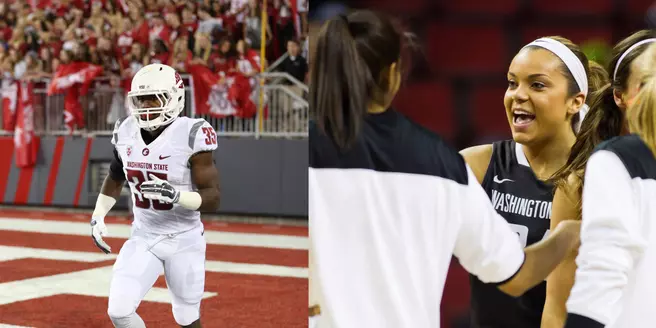
Women's basketball junior Mariah Cooks understands how difficult it can be.
"High school to college is a hard transition," she said.
What makes it hard is the unknown.
"I knew no one," she said, looking back to when she arrived at WSU from her home state of California.
"I didn't have any family in Washington,” Cooks added. “I didn't have any friends."
But she is quick to add, "Now I do."
Football senior Marcus Mason knew the feeling that Cooks experienced as a freshman.
"Summer is when you make your friends that will last a lifetime," said Mason. "All my friends that I'm really close with, we call ourselves 'Super Friends'.
"They were made through the bridge program."
The bridge program Mason refers to is the Washington State University Summer Advantage program.
The program is billed by WSU as "An opportunity to adjust gradually to the new academic demands of college life." It is a six-week, six-nine credit “mini-semester” that provides incoming WSU students the opportunity to become adjusted to college life at a slower pace and in a more personal manner than what they might experience during the fall semester.
The program within the athletic department has grown since it started in 2001 when four student-athletes participated in two sports (men’s and women’s basketball). As the NCAA has allowed schools to increase resources to the program, it has grown to 57 student-athletes encompassing six sports (men’s basketball and women’s basketball, and the fall sports: football, volleyball, soccer, cross country) that participated in 2014.
One of the 57 student-athletes is freshman cross-country/track & field athlete Sam Levora.
"I can't stress enough how much this program helped me out," said Levora. "It gave me real insight of what it's going to be like to be part of Cougar Athletics and what is expected of being a student-athlete."
The 57 freshman student-athletes earned a 3.55 GPA during the summer, a part of the 290 student-athletes who earned at least six credits during summer school, compiling a cumulative 3.17 GPA.
The program is called “Summer Bridge” because of what it symbolizes, serving as a bridge from high school to college.
"Our commitment to an exceptional student-athlete experience begins with our Summer Bridge program," said Chris Cook, Associate Director of Athletics for Student-Athlete Development. “By partnering with the Summer Advantage program, we have been able to provide incoming student-athletes with a foundational academic and social transition to WSU."
And Cook says the program is tied around more than academics.
"Not only does the program allow student-athletes to earn college credits and improve their academic skills, it gives them an opportunity to discover campus resources, and build a support network and a community of friends," added Cook.
"In essence, they come to understand WSU as their new home away from home."

Freshman Sam Levora (pictured left at a Summer Bridge activity and right running for Sandpoint High School) says the Summer Bridge program gave him real insight of what it's going to be like to be part of Cougar Athletics and what is expected of being a student-athlete.
It is a home that keeps a student-athlete busy for the entire day.
"You're thrown right in,” said Cooks, who is majoring in political science/pre-law.
“But they help you get through that," she explains of the support the student-athlete development staff gives.
Cooks remembers beginning her day with 6 a.m. workouts and having her day ending with Summer Bridge activities 12 hours later, and then starting the schedule over the next day.
But the full days in the summer assist with making the demands of a busy in-season schedule provides more manageable.
“It allowed me to get ahead,” said Mason, who is majoring in criminal justice. “I started to build more credits and allowed me to take harder courses in the summer.
“I would have less to worry about,” Mason added. “I would have free time to study and get ahead in school. It makes the season easier to handle because you don't have to stress as much.”
The student-athletes’ connection to the program does not end after their freshman year. Those who have participated come back to address the incoming freshman student-athletes.
Cooks was one who delivered a message this past summer.
"I told them what college was like, what you need to stay away from and how you have to use your head in everything you do because you're representing Washington State University,” she said.
And it resonated.
“It gave me real insight of what it's going to be like to be part of Cougar Athletics and what is expected of being a student-athlete,” said Levora about what he took away from Cooks’ message.
As Levora, who is interested in pursuing business management as a major, embarks on his Cougar athletic career, he looks back on the program as giving him a head start.
“I'm happy I got that transition to the team early instead of getting in the fall and making the adjustment to school and competition at that time,” he said.
And as the current student-athletes look back to when they participated in the program; they view it as the launching point of when they became a Cougar.
"It's an awesome program," said Cooks. "It helps you get acclimated, helps you comfortable with the university, with each other, and with your academic advisors. It helps you to start to use their resources.
"When fall semester starts, you're ready. You have friends. You have resources. You know you are going to be okay because of the program."