Washington State University Athletics
Leaders Beyond The Field: Bill Moos
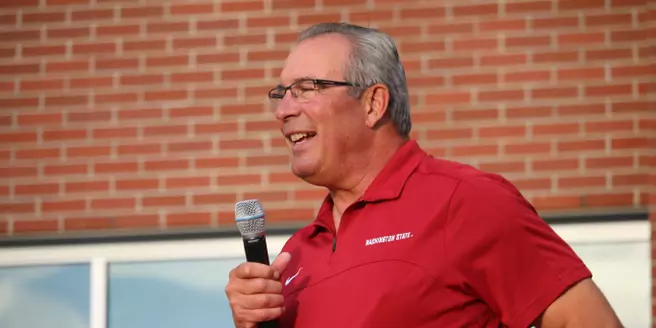
Reprinted with the permission of the National Football Foundation & College Hall of Fame.
Read the original article, and more like it, at FootballMatters.org
Washington State University Athletic Director, Bill Moos, has had a career that is the very definition of coming full circle. First, he was a star football player for WSU in the early 1970s. Then he took a job as the student assistant football coach in 1973. After holding various other jobs, he returned to Washington State as the assistant athletics director, and then the school’s associate director. His career skyrocketed after that, as he became the AD and oversaw the rise of two major universities, Montana and Oregon. Now, over 40 years after he first stepped foot on the Pullman campus as a student-athlete, he is taking WSU to new heights. In this exclusive interview for FootballMatters, Moos talks about his leadership strategy and how playing football has helped shape the man he is today.
Football Matters: When you were a kid, what originally drew you to the sport of football?
Bill Moos: Well, I’d say as a young boy growing up in the wheat fields of eastern Washington, the thing I looked forward to in the fall was my mom and dad, who are Washington State graduates, taking me and my sister to homecoming, down in Pullman. When I saw the color and the pageantry and the excitement I started dreaming that maybe one day I could be a college football player. It really started right then and there.
FM: What was it like for you the first time you finally got to play football after watching it as a child for so many years?
BM: Well, my story might be a little bit unique because in the small school I went to we only played eight man flag football. But in 8th grade my dad was appointed Director of Agriculture so we moved to Olympia, which is the state capitol, and I ended up attending the second largest high school in the state. When I got my first contact in a game, I got it pretty good.
FM: The pads and the equipment and getting hit must have been a totally new experience.
BM: Completely. I didn’t know how to put my gear on or anything. I was very fortunate because it was an excellent school, a great football tradition, and I played for the legendary coach, Jack Swarthout, who went on to coach the University of Montana for a couple years. Then I played for Bob Dunn, who had been a quarterback at the University of Washington. I had real good teachers, coaches, mentors and learned to play the game the proper way.
 FM: What were some of your biggest takeaways about life and football after playing for such prominent men?
BM: I played for Jim Sweeney, a blood and guts guy. And my line coach was Joe Tiller, who went on to take Purdue to the Rose Bowl. I have to say, those two gentlemen made a man out of me in a lot of ways. First of all, I found out that I could be better than I thought I was in a lot of respects. It really set a foundation for me for the rest of my career, knowing that when the chips are down you know how to handle it; how to prepare and how to be mentally prepared is so important. They taught me how to gain confidence through a variety of ways, and those are lessons that I’ve taken with me
FM: How have the life lessons and traits you’ve learned from your days on the field translated to your career as an athletic director?
Leach-MoosBM: I’ve been an athletic director at Montana, Oregon, and Washington State and I’ve used football analogies at all three. When I started five years ago at Washington State, for example, I gathered 185 people in the room and my message was, when you have a football team, the objective in the huddle is to get into the end zone. Now you’re going to have people that are going to be more widely recognized, your quarterback, your receivers, your running back… but as a team, if you try to get into that end zone without that left tackle and that right guard you’re not going anywhere.
I then explain that it’s the same way we have to look at our business. We’ve got people in the business office, the fundraisers, the marketing people, the trainers, and on down the line and we can’t get to where we want to be without everybody following the same playbook.
 FM: That speaks to the idea of being a part of something greater than yourself. Of knowing your role and doing your job.
BM: Yes. And I make a point of showing that I’m sincere about this, so I don’t spend all my time with the people that are getting the headlines. I make sure that I’m in the trenches with those that do their job both in and out of the spotlight.
FM: At each of the schools you’ve mentioned you were in charge of changing an entire culture on campus. How do you get everybody to elevate their game and not accept mediocrity on any level?
BM: One of the things I did at all three jobs is spend my first 120 days evaluating everything from top to bottom. I sit down with every single employee from the head football coach to the night custodian, the head baseball coach to the groundskeeper. I meet in their environment. I go to their office or where they work and I ask some key questions. For instance, I’ll ask: So what’s good about Washington State athletics right now? What could be better? What do you think we need to get a competitive edge? What are your personal and professional ambitions, because I want to help you?
I’ll take tons of notes on that and then I’ll follow up. I want people to get a feeling that I genuinely care about them and what they’re doing because I do. After that I then usually form a senior staff and build a blueprint about what we’re going to do together. We spend two or three days brainstorming about where we’re going to go and then people have ownership in the plan and they’ll take pride in executing it.
I tell them all the time, and I tell people when I’m speaking: when you’re going to go build a house, you’re not just going to take your saw and your hammer and your ten penny nails, you’re going to need a plan and if you believe in the plan, the end result will be beautiful.
There are no quick fixes or the wind will blow it down. You have to take the plan one thing at a time. That’s how I was taught when I was playing football. I went to a program that was 1-10 my first year and it was grueling. By the time I was finished, we were fifteenth in the nation. Again, I draw from that and the personal sacrifices and the mental toughness and the ability to become brothers with your teammates.
FM: How special is it that you get to return to your alma mater as the athletic director after you had such a distinguished playing career?
BM: After my last job, I thought I was done. My wife and I went and built a cattle ranch. As a young boy growing up, all I ever wanted to be was an athlete and a cowboy. I’ve been in athletics all my life so we had bought this land when we were in Oregon and held onto it. It was raw land, a beautiful piece of property, and we went up and built it from scratch. There was really about two years there where the sports page, for the first time in my life, might be the last section I read in the newspaper.
But after about two years, I really started to miss it. Of course, I didn’t miss the travel and I didn’t miss the long hours. What I missed were the student-athletes and having an opportunity to have a positive impact on those young people between the age of 18 and 23. That’s the most rewarding part of it. And if I’m being completely honest, the other thing I missed was game day.
FM: How could you not?
BM: When the Washington State job opened up and President Floyd asked me if I wanted to come home, I thought, what a thrill to finish my career where I started it when I was an 18 year old college football player and a student. It is very, very special. He was a fabulous president. He passed away earlier this summer, so the direction and the focus that he had for the entire institution is still in place, but what he was so good with me is, he really didn’t know a lot about sports but he realized the importance of intercollegiate athletics in the big picture.
He had a lot of trust in me and my experience in the industry and let me run that program and it’s very sad that he’s not going to be able to see the fruits of all the things he was instrumental in doing. I’ll always appreciate the fact that he gave me a chance to come home where it all began. It felt so good because the truth is, the foundation of my adult life is built on my experience playing major college football. Now I can give back to the institution that let me play.